
Surpassing Darkness & Harsh Conditions: An RV1126B-Based Panoramic AI Monitoring Solution for Power Transmission Lines
Compared to round-the-clock visual intelligent monitoring, traditional field-based power line monitoring solutions suffer from the following critical shortcomings:
(1) Inefficient Manual Inspection, Insufficient Coverage
Manual inspections are infrequent, costly, and can take days or even weeks for long-distance lines. Inspections completely stall under harsh weather conditions, making it difficult to handle faults and accidents promptly.
(2) Pure Sensor Devices Only Measure Data, Cannot Restore the Scene
Hardware devices like GPS and inclinometers can achieve millimeter-level deformation monitoring. However, upon alarm, they only output numerical data, unable to visually restore the scene or distinguish the cause of faults.
(3) Conventional Video Surveillance Has Night Vision Blind Spots and Limited Field of View
Standard cameras perform poorly at night. High-power supplementary lighting consumes too much energy and is unsuitable for off-grid power supply in remote areas. Furthermore, fixed-angle cameras have significant blind spots, making it difficult for a single device to cover the entire area.
In summary, traditional monitoring methods have respective shortcomings: manual inspection ''can see but cannot measure accurately'', pure sensors ''can measure accurately but cannot see'', and conventional cameras ''can see but struggle with darkness and have blind spots''. For the ''last kilometer'' of monitoring high-voltage lines in remote areas, there has always been a lack of an all-weather, blind-spot-free, and intelligent visual monitoring solution.
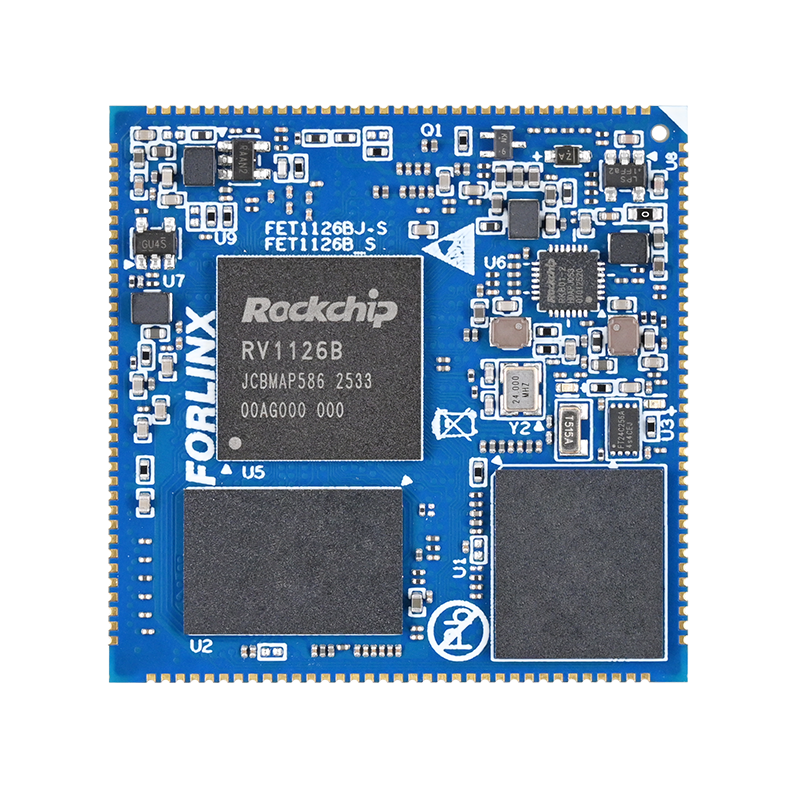
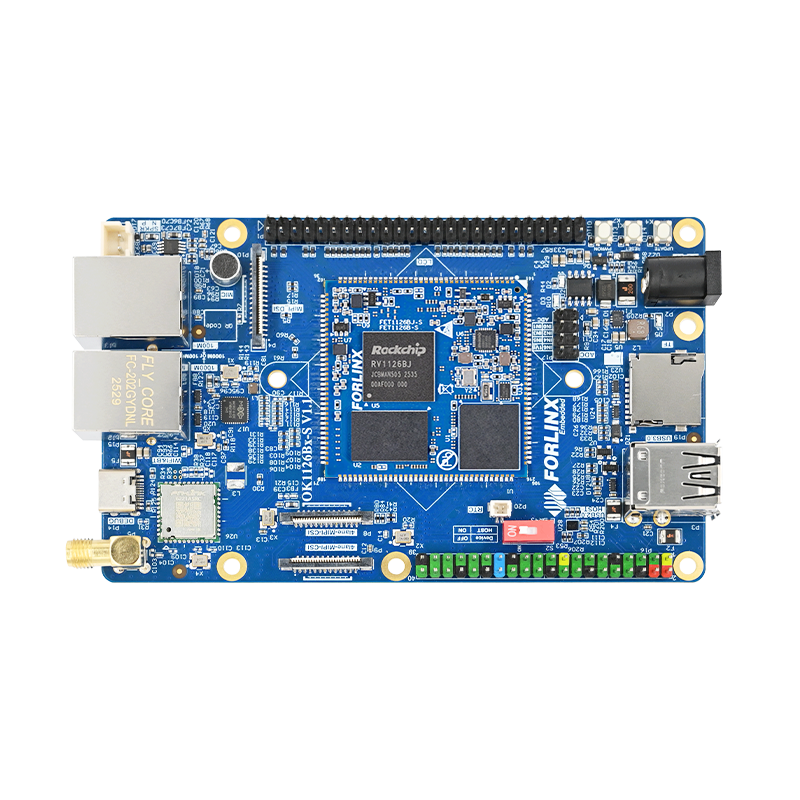
Addressing the multiple shortcomings of traditional monitoring methods, Forlinx Embedded has developed a Panoramic Visual Integrated Monitoring Solution based on the OK1126BJ-S development board. This solution offers a comprehensive breakthrough from multiple dimensions: night vision imaging, full-area coverage, intelligent recognition, and low-power endurance.
1. Achieving Clear Nighttime Field Imaging
Nighttime is the peak period for transmission line security incidents: mountain fires often spread late at night, illegal excavation and mechanical construction damage mostly occur in the early morning, and unauthorized personnel intrusion often happens in dark environments. Night vision capability directly determines the practical value of remote monitoring equipment.
The Starlight-level Sensor solution utilizes a 0.01lux image sensor, suitable for extremely low-light environments like starry nights (starlight illumination ≈0.01lux, full moon only ≈0.2lux). Without additional lighting, it outputs 1080P full-color HD video, enabling all-weather covert monitoring.
Leveraging the Starlight-level Sensor + AI-ISP Intelligent Image Processing Engine, it significantly optimizes imaging in low-light conditions:
AI Intelligent Pixel-level Noise Reduction (AIBNR)
Unlike traditional fixed-parameter 3DNR noise reduction algorithms, AI-ISP uses NPU deep learning models for frame-by-frame processing, effectively suppressing noise in dark areas while completely preserving texture details in bright areas. Even in 0.01lux extreme darkness, the image remains clean, transparent, and object outlines are sharp.
AI Dynamic Defogging Algorithm
Mountainous transmission lines often experience fog, rain, and snow. The system can real-time identify haze concentration and dynamically adjust defogging intensity. Combined with anti-shake technology, video remains clear without blurring or trailing even when the tower sways slightly in strong winds.
Hardware Architecture Advantage: AI-ISP has a dedicated independent processing unit. Image optimization does not consume main NPU computing power. Night vision image processing and backend AI recognition run synchronously without competing for resources.
Forlinx Embedded SC285SL+OK1126BJ-S Development Board Night Vision Demo:
Comparative tests show: under the same no-light environment, this solution’s 1080P@60FPS Starlight module produces clean, sharp images. Ordinary consumer-grade smartphone 1080P@30FPS cameras show dense noise and lost details. This fully validates the superiority of the Starlight Panoramic Visual Integrated Monitoring Solution in remote low-illumination scenarios.
2. 360° Stereoscopic Vision, Full-Area Blind-Spot-Free Monitoring
A single lens has a limited field of view. This solution employs a four-channel 1080P@30FPS AHD camera stereoscopic vision array. Each channel is paired with a 150° wide-angle lens. Through seamless algorithmic stitching, it achieves a horizontal 360° panoramic view, presenting the complete tower and power line scene on a single screen.
The device automatically generates panoramic snapshots every 15 minutes. After overlaying device watermarks and GPS monitoring data, they are automatically uploaded to the grid management platform, ensuring no observation blind spots above/below the tower or in the surrounding power line. Equipped with mature multi-channel synchronous capture, precise image registration, and intelligent pixel fusion algorithms, the panoramic stitched video has smooth transitions, with no obvious color differences, ghosting, or misalignment at lens junctions, truly achieving comprehensive stereoscopic coverage of remote towers.
Forlinx Embedded Panoramic Stitching Demo:
3. Edge AI Intelligent Vision: From Seeing to Understanding
The solution natively integrates AI human shape detection algorithms, capable of real-time framing of intruding personnel for basic anomaly alerts. It also reserves sufficient edge-side AI computing power, supporting customized recognition model development based on power grid scenarios. The entire pipeline is open and adaptable to various monitoring needs:3
Custom Intelligent Detection Algorithms
Models can be deployed as needed: mountain fire identification (smoke, open flame early warning), external force damage identification (construction machinery/vehicles approaching the tower base), line defect identification (broken strands, damaged insulators), floating foreign object identification (plastic, tarpaulin hanging on lines), etc. Supports customer-developed model fine-tuning or rapid iteration based on general recognition models, adapting to differentiated monitoring scenarios like transmission, mining, and water conservancy.
Custom Data Collection Strategies
Image capture frequency, alarm trigger conditions, and upload data types are all flexibly configurable. Supports the complete business chain of cloud model training and edge-side real-time inference.
Custom Alarm & Linkage Logic
AI inference is completed locally on the edge device; alarm response does not rely on network transmission. Alarm thresholds, recording triggers, image wake-up uploads, and other linkage strategies are freely configurable. Panoramic views and AI alarm information are linked for push notifications, forming a complete hazard handling loop.
Different monitoring scenarios have significantly different risk types: power lines focus on preventing mountain fires and construction damage; slopes/mines prioritize landslides and personnel intrusion; water conservancy points focus on floating debris and abnormal water levels. The open customization architecture ensures algorithm autonomy, rapid scenario adaptation, and continuous functional iteration. Whether customers develop their own algorithms (Forlinx Embedded provides underlying computing power and technical development support) or opt for one-stop custom development (full-process delivery: data collection, model training, edge deployment), the solution is flexible. Using the hardware platform as the foundation, it allows industry-specific algorithms to have room for autonomous development.
4. Accompanying Implementation Recognition Effects
4.1 Intelligent Mountain Fire Detection
Accurately frames dense smoke/open flame areas and outputs confidence levels, enabling warnings in the early stages of fire.
4.2 Insulator Defect Identification
Automatically identifies the status of multiple insulator groups on the tower, marking abnormal points.
4.3 Line Foreign Object Identification
Accurately locates floating debris like hanging plastic/tarpaulin and promptly pushes alarms.
5. AOV Low-Power Field Test, Off-Grid Self-Sustaining for 90 Days
Remote monitoring sites lack grid power. Equipment endurance is the core prerequisite for long-term stable operation. The entire solution significantly reduces overall power consumption through AOV (Always-On Video) technology, making it suitable for solar-powered scenarios
Platform Power Consumption Field Test Data:
| Operating State | Measured Power Consumption | Description |
| AOV + Cameras + Sleep | About 0.1W | Deep sleep standby, cameras remain ready to wake |
| AOV + Cameras + Detection every 1000ms | About 0.19W | Low-power polling, periodically ''wakes to look'' |
| AOV + Cameras + Recognizing human shapes | About 1.6W | AI recognition active state, instant response upon event |
Endurance Calculation (Example: 18W Solar Panel + 32Ah Battery)
- Sleep Standby Mode (0.1W): Theoretical endurance over 90 days.
- Per-second Polling Detection Mode (0.19W): Theoretical endurance ~50 days.
- Continuous AI Recognition Full Load (1.6W): Can run uninterrupted for ~6 days.
Paired with an 18W solar photovoltaic panel for continuous daytime charging, the device remains stable on standby even during dozens of consecutive rainy days. AOV Core Logic achieves ''Wake-on-Demand'': Normally operates at an extremely low 0.1W standby. Once the camera captures a moving target, the device instantly wakes up and operates at full computing power to complete recognition and recording. This makes power-intensive functions like 24/7 starlight night vision, scheduled panoramic snapshots, and real-time AI recognition feasible in off-grid remote environments.
AOV Effect Demo:
6. Development Board Industrial-Grade Strength
Industrial Temperature Range, Stable Operation
Industrial-grade hardware design, operates uninterrupted in -40°C to 85°C environments, suitable for plateaus and extremely cold mountainous areas.
High Anti-Corrosion Protection
Passes 96-hour salt spray test, suitable for long-term stable deployment in coastal high-corrosion areas.
Disconnection & Resume Transmission Fault Tolerance
When the 4G network is interrupted, videos and snapshots are cached locally. All data is automatically retransmitted upon network recovery, achieving zero-loss storage.
Summary
This high-voltage line Starlight Panoramic Visual Monitoring Solution, developed based on RV1126B, precisely matches the core needs of unmanned inspection for transmission corridors. It integrates five core capabilities: Starlight Night Vision for all-weather clarity, Four-Channel Panoramic for complete coverage, Edge AI for intelligent understanding, GPS Sensing for precise measurement, and AOV Low-Power for long-term endurance A single hardware unit integrates multiple monitoring capabilities, providing 7×24 uninterrupted protection for transmission line safety.
The solution is adaptable to various remote monitoring scenarios such as transmission corridors, slope geology, open-pit mines, and water conservancy pipelines, creating an integrated visual monitoring solution for intelligent inspection of high-voltage lines. If you need the complete technical white paper or wish to customize a dedicated industry monitoring solution, please feel free to contact us anytime.