

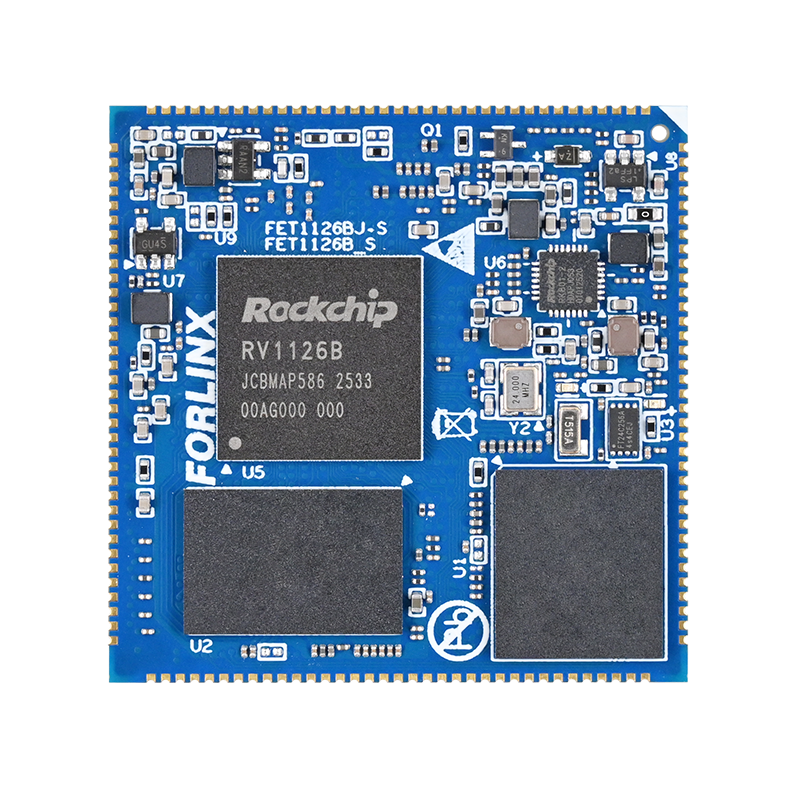

FET1126Bx-S System on Module
CPU: Rockchip RV1126B/RV1126BJ
Architecture: 4x [email protected]
Frequency: 1.3GHz,1.6GHZ
RAM: 1GB/2GB/4GB LPDDR4
ROM: 8/16/32/64GB eMMC
System: Linux 6.1.141
FET1126Bx-S (Rockchip RV1126B/RV1126BJ) Industrial System on Module / Computer on Module
The FET1126B-S/FET1126BJ-S system on module(SoM)/computer on module is developed and designed based on the Rockchip RV1126B/RV1126BJ. It is a low-power, cost-effective solution optimized for edge-side AI computing. By integrating quad-core ARM Cortex-A53 processors and a 3 TOPS NPU, it excels in real-time video analysis and target recognition for smart industries, parks, and construction sites. Rigorously tested by Forlinx Embedded Laboratory for industrial-grade stability, it ensures reliable performance with a 10-15 year longevity for consistent long-term supply.
Highlights:
- Compact Size: 40mm × 40mm, full pinout.
- AI Performance: 3 TOPS NPU, RKNN support.
- Display: MIPI DSI and RGB interfaces.
- Connectivity: RGMII, UART, CAN FD, SPI.
- AI Software: Ready-to-use edge AI routines.
- Industrial Grade: -40°C to +85°C.
Functional Diagram
Full Upgrade
Compared to the RV1126, it offers three major enhancements: boosted CPU and NPU performance, plus an upgraded OS. Enjoy a more powerful, intelligent, and seamless device AI journey.
Comprehensive Pinout & Rich Connectivity
Stamp hole + LGA connection. All functional pins of the RV1126B/RV1126BJ are fully led out, including display interfaces (MIPI-DSI, RGB LCD),
network interfaces (Gigabit RGMII, 100Mbps Ethernet), and various peripherals (CAN FD, UART, SPI, I2C, PWM, ADC, etc.).
The GPIO layout is fully compatible with the Raspberry Pi 40-pin standard.
3TOPS NPU Empowers Edge AI Inference
Independent built - in NPU , providing up to 3TOPS@INT8 AI computing power, supporting INT8/INT16 mixed - precision operations,
and can efficiently run typical edge AI target recognition models such as face detection, safety helmet recognition, fire and smoke alarm,
and area intrusion, realizing local real - time decision - making without relying on the cloud.
Powerful Vision & Multi-channel Video Analytics
-40°C to +85°C Stable 24/7 Operation
The FET1126BJ - S SoM supports - 40°C~+85°C operation, delivering excellent reliability and environmental adaptability in complex settings.
LPDDR4 Memory Design for More Scenarios
An LPDDR4 memory design for lower power consumption. DDR4 commercial-grade chips operate at 0°C - 70°C, while LPDDR4 ones cover - 20°C - 85°C.
With RV1126B (- 20°C - 85°C) and eMMC (- 25°C - 85°C)'s wide-temperature features, the commercial-grade SoM works at - 20°C - 85°C, offering low cost and wide-temperature performance.
It combines low cost with wide-temperature characteristics.
Full Software Ecosystem & Rapid AI Deployment
Equipped with the Linux 6.1 OS, it's a major upgrade from the previous - generation RV1126. It offers full BSP support, including kernel source code, file system, drivers, and the RKNN toolchain. It's also compatible with model conversion of mainstream deep - learning frameworks like TensorFlow, PyTorch, Caffe, and MXNet.
RPi 40-Pin GPIO Compatible for Quick Start
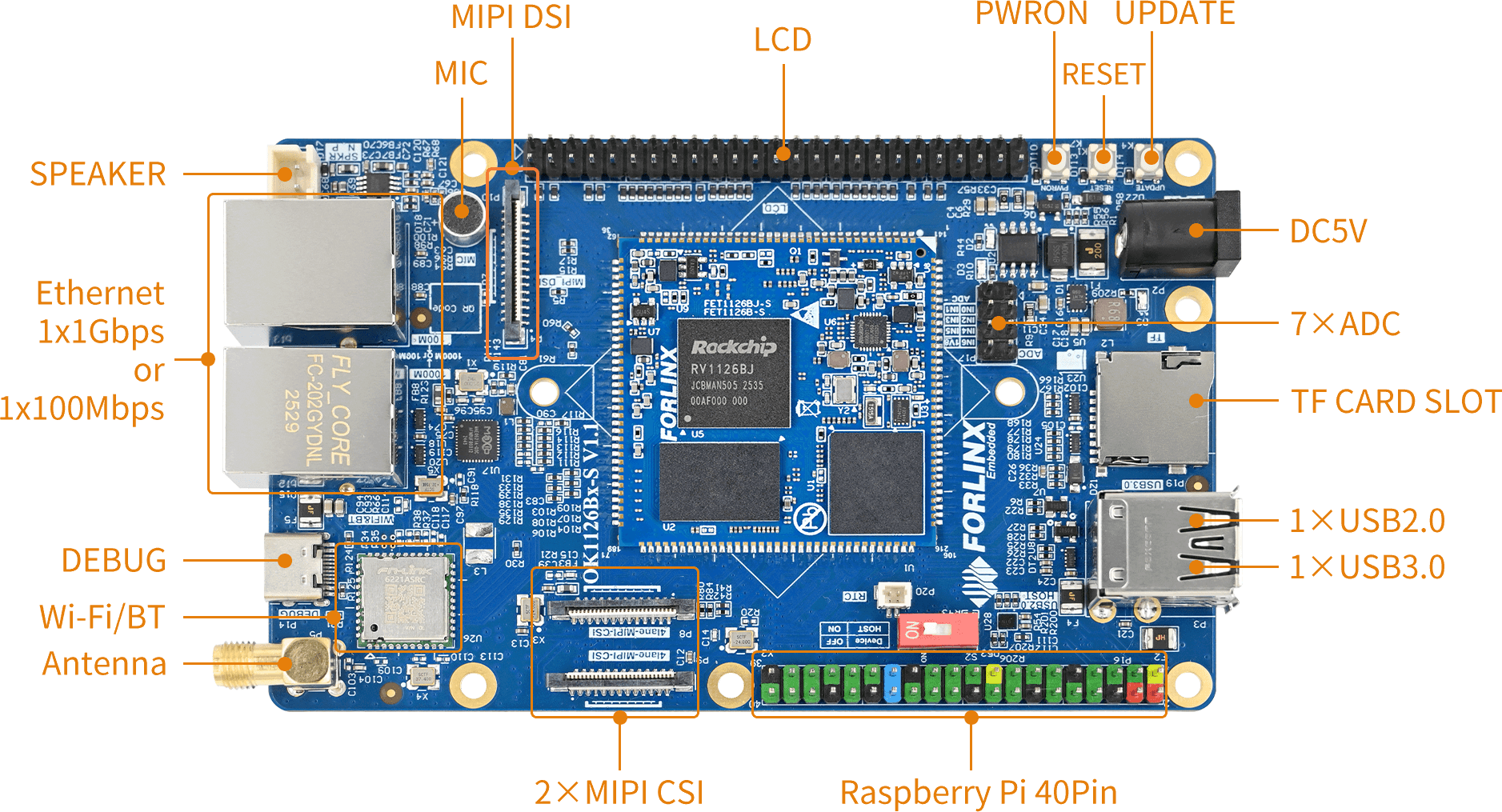
The compact development board features 2 x network ports, display, USB and Wi-Fi interfaces, plus pins matching Raspberry Pi 40-Pin GPIO for testing FET1126B-S/FET1126BJ-S SoM functions and AI development.
Compact Development Board with Complete Interfaces
Compact size, measuring only 120mm×75mm, offers interfaces like network ports, 2 x MIPI - CSI, 1 x MIPI - DSI, and 40Pin GPIO (with UART, SPI, IIC).
It can flexibly expand peripherals and sensors, ideal for embedded vision, edge computing, AIoT, and AI inference.
The Choice for High - End Applications
RV1126B/RV1126BJ SoM&SBC Video
All New FET1126BJ-S SoM: Cost-Effective Edge AI Solution
▊ Hardware Features
| RV1126B / RV1126BJ System On Module Basic Parameters | |||
|---|---|---|---|
| Processor | Rockchip RV1126B | Rockchip RV1126BJ | |
| CPU: | 4 × Cortex-A53, up to 1.6 GHz | 4 × Cortex-A53, up to 1.3 GHz | |
| NPU: | 3 TOPS @ INT8 | ||
| GPU: | No 3D GPU, only 2D RGA is supported. | ||
| ISP: |
VICAP input: RX raw8/raw10/raw12/raw14/raw16 Maximum input: 12 MP @ 20 fps Minimum input: 264 x 264 |
||
| AI ISP: |
Maximum input: 8 MP @ 30 fps Maximum resolution: 4096 x 4096 |
||
| VPU: |
Video Decoder:
Video Encoder:
JPEG Decoder:
|
||
| RAM | 1 GB / 2 GB / 4 GB LPDDR4 | 1 GB / 2 GB / 4 GB LPDDR4 | |
| ROM | 64 GB eMMC | 8 GB / 16 GB / 32 GB eMMC | |
| Operating Temperature | -20°C ~ +85°C | -40°C ~ +85°C | |
| Working Voltage | DC 5 V | ||
| Form Factor | Castellated holes + LGA (A total of 237 pins are led out, including 140 pins in the form of castellated holes with a center-to-center pin spacing of 1.0 mm, and 97 pins in the LGA form with a center-to-center pin spacing of 1.27 mm) | ||
| Dimension | 40 mm x 40 mm | ||
| OS | Linux 6.1.141 | ||
| Flashing | USB OTG, TF Card | ||
| RV1126B / RV1126BJ System On Module Function Parameters | ||
|---|---|---|
| Function | QTY | Parameter |
| Display | 1 | Supports 1 x display output, with a maximum supported resolution of 1920 x 1080 @ 60 fps. |
|
Supports multiple display interfaces: RGB: 24-bit MIPI-DSI: 4-lane, 1.5 Gbps/lane BT.656 / BT.1120 |
||
| MIPI CSI | Up to 2 |
Supports 2 x 4-lane, 2.5 Gbps/lane Supports 2 x MIPI CSI / LVDS / SubLVDS DPHY Each MIPI DPHY V1.2 has 4 lanes, with a data rate of 2.5 Gbps per lane Each interface can be configured as a 2x2 data channel port Supports virtual channels |
| DVP | 1 | Supports 8/10/12/14/16-bit data, with a maximum I/O frequency of up to 150 MHz |
| Supports BT.601 / BT.656 and BT.1120 inputs. | ||
| Ethernet | 1 | 1 x MAC can be used for either 1 x RGMII interface or 1 x 100 Mbps interface (the CPU has 1 x built-in 100 Mbps PHY) |
| USB | 2 | 1 x USB 2.0 Host |
| 1 x USB 2.0/3.0 DRD | ||
| UART | Up to 8 | Maximum supported baud rate is 4 Mbps. UART1 - UART7 support automatic flow control |
| CAN-FD | Up to 2 | Supports CAN 2.0 A/B |
| SDIO 3.0 | Up to 2 | 1 x TF card interface, supporting high-speed cards; and 1 x SDIO with a 3.3 V level |
| DSMC | Up to 1 | 1 x host interface for connecting to an FPGA |
| Supports 4 chip select signals, as well as 8-wire or 16-wire serial transmission modes. | ||
| FSPI | Up to 1 | Supports startup and 1/2/4-bit modes |
| SPI | Up to 2 | Supports both master and slave mode |
| I2C | Up to 5 | Supports 7-bit and 10-bit address modes up to 1 Mbps |
| PWM | Up to 27 | Supports up to 27 channels of PWM |
| ADC | Up to 24 | 24 single-ended inputs, 13-bit, 2 MSPS |
| SAI | Up to 3 | Supports both master and slave mode |
| Audio ADC | Up to 2 | 2 x differential MIC inputs and 2 x Audio DSM differential outputs |
| GPIO | Up to 118 | The total quantity excluding the internal use of the SoM |
▊ OK1126Bx-S Carrier Board
Accelerate Your Development Cycle with OK1126Bx-S Development Board
Eliminate the need to build hardware from scratch with the OK1126Bx-S, a production-ready evaluation platform designed to bridge the gap between initial concept and mass production. By leveraging a proven SoM + Carrier Board architecture, you can bypass complex low-level design and focus entirely on your application logic. This modular foundation not only facilitates rapid evaluation and a seamless transition to your final product but also offers streamlined customization with minimal design risk. Coupled with comprehensive Linux support and robust technical resources, it provides a pre-configured environment to jumpstart your software development immediately.
| OK1126Bx-S Development Board Function Parameters | ||
|---|---|---|
| Function | QTY | Parameter |
| LCD | 1 | Led out via pin headers, supporting capacitive touch screens and backlight brightness adjustment |
| MIPI DSI | 1 | 4-lane MIPI DSI interface, supporting capacitive touch screens and backlight brightness adjustment. |
| MIPI CSI | 2 | Led out through an FPC connector, with 4 lanes + 4 lanes |
| UART Debug | 1 | Integrated into a Type-C port, which can be connected to a computer for debugging |
| USB 2.0 | 2 |
1 x USB_HOST interface is led out via a USB connector 1 x USB_OTG interface is led out through a Type-C connector for OTG burning, or combined with USB 3.0 and led out via a USB 3.0 connector. |
| USB 3.0 | 1 | 1 x USB 3.0 HOST interface is led out via a USB 3.0 connector |
| Ethernet | 1 | Standard RJ45 sockets are used for connection. 1 x 100 Mbps interface and 1 x 1000 Mbps interface. Since the CPU has only one MAC, only one can be selected at a time, so they cannot be used simultaneously. |
| UART | 1 | UART5 is led out through a 40-pin header |
| CAN | 2 | CAN0 and CAN1 are led out through a 40-pin header |
| I2C | 2 | I2C3 and I2C4 are led out through a 40-pin header |
| SPI | 1 | SPI1 is led out through a 40-pin header |
| Wi-Fi | 1 | Single-antenna 2.4 GHz & 5 GHz. |
| Bluetooth | Wi-Fi Dual-band 1x1 802.11ac + Bluetooth 4.2 | |
| ADC | 7 | 7 x ADC are led out through pin headers |
| RTC | 1 | An external CR2032 coin-cell battery is used to keep time when powered off. |
| Speaker | 1 | Output through a power amplifier chip, allowing an external 4 Ω / 3.3 W speaker to be connected |
| MIC | 2 | 1 x is connected to the on-board electret microphone, and the other 1 x is not led out |
| FSPI | 1 | An external Flash chip can be connected to support startup |
| TF Card Slot | 1 | Supports a TF card with a maximum SDR104 speed |
| KEY | 3 | Buttons for CPU reset, power on/off, and startup item selection |
▊ Accessories
Please click here to get more information about the supported modules and accessories.
▊ Documentation
Reference Manuals
Hardware Related
Product Datasheet
User Guide
Carrier Board Schematic
Carrier Board PCB
SoM Pinmux
Firmware Related
OS Image
Testing Demo
Source Code
Manual
Request a Quote
Fill out the form below for volume pricing or technical specifications. We'll get back to you within 24 hours.
▊ How To Buy & Shipment
1. Order Online: We have an online store on Alibaba. Please contact us for details.
2. Order Offline: Send your inquiry to [email protected].
3. Payment Terms: 100% T/T in advance.
1. Delivery: Goods shipped by express upon receipt of payment.
2. Lead Time: Sample orders within 5 working days; bulk orders 6 weeks.
3. Shipping Charge: Buyers bear the shipping cost.
▊ Forlinx Recommended Products
Architecture: 4x Cortex-A76+4x Cortex-A55
Frequency: [email protected]/1.6GHz, [email protected]/1.3GHz
RAM: 4GB/8GB/16GB LPDDR4x
ROM: 32GB/64GB/128GB eMMC
Architecture: 4x Cortex-A72+4x Cortex-A53
Frequency: [email protected][email protected]
RAM: 2GB/4GB LPDDR4
ROM: 32GB eMMC
Architecture: 4x [email protected]
Frequency: 1.3GHz,1.6GHZ
RAM: 1GB/2GB/4GB LPDDR4
ROM: 8/16/32/64GB eMMC