
Forlinx Qualcomm Dragonwing IQ8275: Multi-Channel Video Analysis solution at electronica 2026
A multi-channel industrial video analysis demonstration on the Qualcomm Dragonwing IQ8275. VPU decoding, GPU preprocessing and NPU inference handle mixed USB and local video inputs, with QNN-compiled detection for personnel, helmets, smoke and flames.
electronica 2026 in Munich closed its doors after November 13. Among the product solutions Forlinx presented that drew wide attention was a multi-channel industrial video analysis demonstration. It examined how mixed USB and local video inputs can be decoded and analysed channel by channel for monitoring tasks. This article looks at how the demonstrated workload was assembled and what it takes to make the detection results reviewable.
Industrial video projects do not all begin with one uniform camera interface. A team may need to test live USB inputs alongside stored video used for model evaluation. Forlinx's Qualcomm IQ-8275 demonstration brings those input types into a tiled analysis view, helping developers inspect the relationship between each source and its detection output.
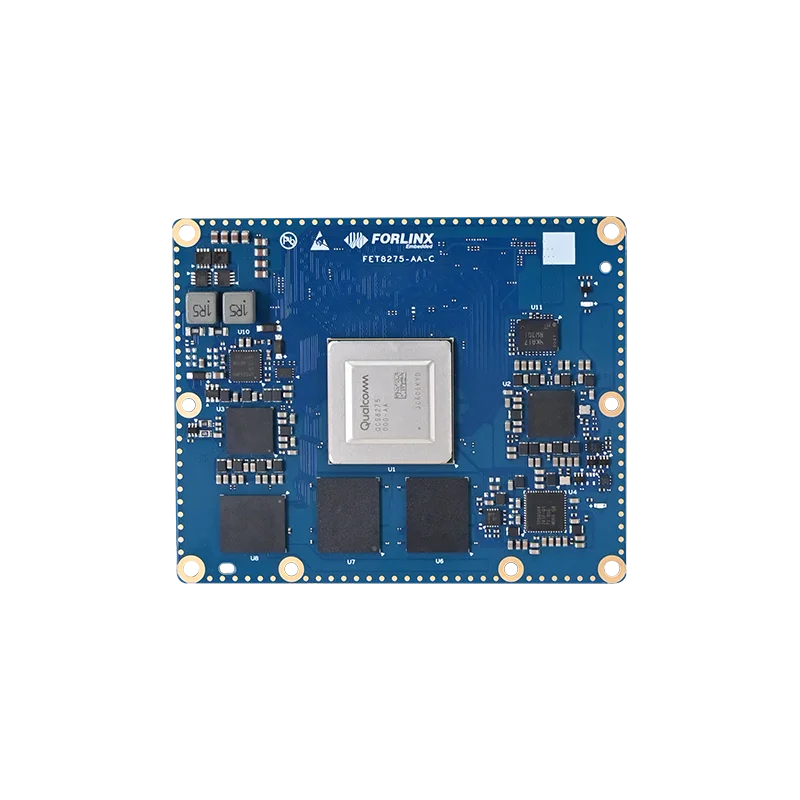
The demonstration combined four live USB camera feeds with 32 local video streams. The corresponding FET8275AA-C module was shown in a 40 dense TOPS configuration. The application decoded and prepared video for inference, then overlaid detection results on the relevant tiles.
Solution configuration at a glance
According to the solution brief, the IQ8275 demonstration uses several independent pipelines: a VPU for parallel hardware decoding of USB cameras and local video streams, a GPU for preprocessing steps such as scaling, format conversion and DMA-BUF handling, and an NPU for multi-channel parallel inference. The YOLOv8 model is compiled with QNN and paired with dedicated industrial-safety algorithms that recognise personnel, safety helmets, smoke, flames and garbage.
The brief cites 40 TOPS of edge AI computing, fair scheduling of multi-stream tasks and zero-frame-drop video switching. Typical scenarios include safety monitoring in factory workshops, centralized multi-stream inspection in industrial parks and large-screen monitoring and operation centres. These describe the demonstrated setup; a pilot should record source rate, analysis rate and output delay separately for the intended stream mix.
Understand what the demonstrated input count means
The 36 sources describe a mixed workload, not 36 directly connected live cameras. Local playback differs from a physical camera path, and a replayed scene is not evidence of performance with every live sensor. Those distinctions are useful when turning a demonstration into an evaluation plan.
For a prototype, identify which feeds are live, which are replayed and which events each source contains. Stored clips can make tests repeatable. Live cameras reveal issues that a clip does not, such as installation angle or changing lighting. Both have a role, but they answer different questions.
Make industrial detection results reviewable
A tiled display gives an overview, while a larger single-channel view helps an engineer inspect a result. For industrial safety-related use cases, the team must define the exact event and the conditions in which a model is expected to recognize it. A generic claim of safety monitoring is not enough to establish the operating rules.
For example, a project could evaluate a defined activity in a marked work area using representative positive and negative clips. The selected event and model should be agreed before testing. The result should be traceable to its source frame so an operator can distinguish an actual event from a false detection.
Use local analysis as part of the system architecture
Keeping inference at the device can allow the analysis path to operate without sending frames to a cloud model. The finished product may still need networking for management, results or updates. Define these paths separately so local inference is not confused with a completely disconnected product.
The compute configuration provides a platform resource, not a guaranteed per-channel result rate. The target model, image size and frame selection affect the workload. Evaluate sustained operation with the intended stream mix, and record source rate, analysis rate and output delay as separate measurements.
Use replay to make model changes comparable
A mixed-input setup can be useful during industrial video development. Consider a team testing a revised model on a defined activity. Replaying the same clips provides repeatable input, while live USB cameras show how the interface behaves with new activity. The engineer can inspect the same event across software revisions rather than relying on memory of a previous live scene.
The advantage is a more controlled evaluation process for the chosen Qualcomm platform. It helps separate a change in the model from a change in the input conditions. Production camera interfaces and deployment workloads still need a matching live evaluation after the software behavior is understood.
Build a focused pilot with Forlinx
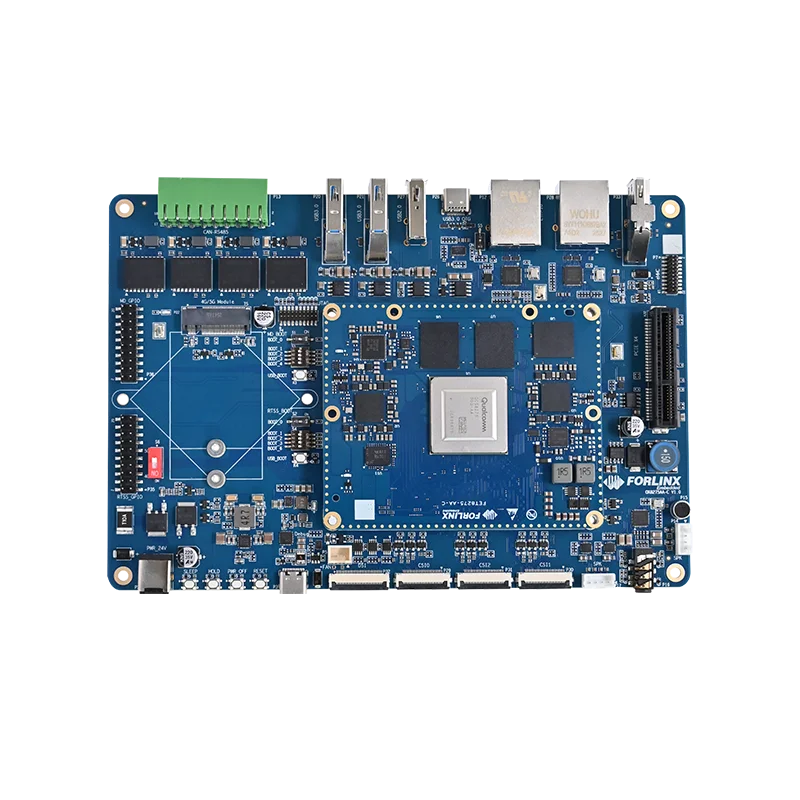
For an initial evaluation, share the input interfaces, number of live feeds and the event examples your application needs to analyze. Our team can discuss the FET8275AA-C platform and a representative software workload. This gives the project a concrete basis for assessing local video analysis and channel-level review.
Frequently Asked Questions
How is the video analysis pipeline split across hardware on the IQ8275?
The brief describes three independent stages: a VPU for parallel hardware decoding of USB cameras and local video streams, a GPU for preprocessing such as scaling, format conversion and DMA-BUF handling, and an NPU for multi-channel parallel inference.
Which AI model and compiler are used?
The YOLOv8 model is compiled with QNN and paired with dedicated industrial-safety algorithms that recognise personnel, safety helmets, smoke, flames and garbage.
How much edge AI computing power is cited?
The brief cites 40 TOPS of edge AI computing, together with fair scheduling of multi-stream tasks and zero-frame-drop video switching. A pilot should record source rate, analysis rate and output delay separately for the intended stream mix.
What does the 36-source figure actually mean?
The 36 sources describe a mixed workload, not 36 directly connected live cameras. Local playback differs from a physical camera path, and a replayed scene is not evidence of performance with every live sensor.
Where is this multi-channel analysis applied?
Typical scenarios include safety monitoring in factory workshops, centralized multi-stream inspection in industrial parks and large-screen monitoring and operation centres.