


FET3588J-UP5 System on Module
CPU: Rockchip RK3588/RK3588J
Architecture: 4x Cortex-A76+4x Cortex-A55
Frequency: [email protected]/1.6GHz, [email protected]/1.3GHz
RAM: 4GB/8GB/16GB/32GB LPDDR4
ROM: 32GB/64GB/128GB eMMC
System: Android14,ForlinxDesktop 24.04,Linux 6.1
FET3588J-UP5 SoM | Rockchip RK3588 Industrial LGA System on Module
The FET3588J-UP5 is an industrial-grade System on Module powered by the flagship 8nm Rockchip RK3588/RK3588J processor. Delivering high-performance edge AI, 8K multi-display capabilities, and rich industrial connectivity in a standardized 50mm × 50mm UP5 LGA package, it empowers compact, high-reliability designs for smart NVRs, edge computing gateways, commercial displays, and intelligent robotics.
Highlights:
- Flagship Octa-Core Performance: 4x Cortex-A76 @2.4GHz + 4x Cortex-A55 @1.8GHz on an advanced 8nm process with high-speed memory support.
- 6 TOPS Powerful Edge AI: Integrated tri-core NPU delivering 6 TOPS INT8 computing power, supporting hybrid computing and the RKNN Toolkit 2 suite.
- 8K Ultra-HD Display & Vision: Supports 8K@60Hz display, four-screen independent display, 8K video codec (simultaneous encoding/decoding), and multi-channel camera inputs.
- Rich Industrial Connectivity & Storage: Equipped with 2x Gigabit Ethernet, 3x SATA interfaces (supporting eSATA), and extensive high-speed CPU peripheral resources.
- Compact & Standardized UP5 Packaging: Ultra-compact 50mm × 50mm LGA design (624 pins) with carrier board design reusability and hardware interchangeability across the UP5 platform.
- True Industrial Reliability: Powered by the RK3588J industrial-grade processor, rigorously tested for harsh environments with multi-OS support (Android, Linux, Forlinx Desktop).
▊ Hardware Features
| Hardware Parameters of FET3588J-UP5 | ||
|---|---|---|
| Processor | Rockchip RK3588/RK3588J | |
| RK3588 CPU:4×[email protected] + 4×[email protected] | ||
| RK3588J CPU:4×[email protected] + 4×[email protected] | ||
| NPU | 6 TOPS, supporting INT4/INT8/INT16/FP16 combined operations | |
| GPU | Mali-G610 MP4, OpenGLES 1.1, 2.0, 3.2, OpenCL 2.2, Vulkan1.2 | |
| VPU |
Hardware Decoding: • H.265, VP9: up to 8K@60fps • H.264: up to 8K@30fps • AV1: up to 4K@60fps |
|
|
Hardware Encoding: • H.265/HEVC, H.264/AVC: up to 8K@30fps |
||
| RAM | 4GB/8GB/16GB/32GB LPDDR4 | |
| ROM | 32GB/64GB/128GB eMMC | |
| Operating Voltage | DC 5V-13V | |
| Operating Temperature | 0℃ ~ +70℃ / -40℃ ~ +85℃ | |
| Net Weight | 15.9g | |
| Connection | LGA (624 pins; the ball pitch of the LGA is 1.25 mm, and the diameter of a single ball is 0.8 mm) | |
| OS | Linux6.1, Android14, Forlinx Desktop 24.04 | |
| System flashing Method |
|
|
| SoM Function Parameters of FET3588J-UP5 | ||||
|---|---|---|---|---|
| Function | Maximum Number | Parameter | Number of interfaces defined by UP5 | Parameter |
| MIPI DC PHY (DPHY/CPHY) *1 | 2 | Supports DPHY or CPHY; 4-channel MIPI DPHY V1.2, up to 2.5 Gbps per lane; 3-channel MIPI CPHY V1.1, up to 2.5 Gbps per lane; | \ | |
| MIPI CSI DPHY*1 | 4 | 2-channel MIPI DPHY V1.2, with a maximum data rate of 2.5 Gbps per lane; every two 2-channel DPHYs can be combined to form a single 4-channel DPHY for a parallel display interface, supporting a maximum resolution of WUXGA (1920 x 1200 @ 60 fps, 165 MHz pixel clock) | 4 | 1 x 4-channel MIPI DPHY V2.0, with a maximum of 4.5 Gbps per lane; 3 x 2-channel MIPI DPHY V1.2, with a maximum of 2.5 Gbps per lane; any two 2-channel DPHYs can be combined into a single 4-channel DPHY to serve a parallel display interface, supporting a maximum resolution of WUXGA (1920 x 1200 @ 60 fps, 165 MHz pixel clock) |
| DVP | 1 | 8/10/12/16-bit standard DVP interface, with a maximum data input rate of 150 MHz; supports BT.601/BT.656 and BT.1120 VI interfaces; | \ | |
| HDMI RX | 1 | Supports HDMI 2.0 at 3.4 Gbps to 6 Gbps; supports HDMI 1.4b at 250 Mbps to 3.4 Gbps; supports HDCP 2.3 and HDCP 1.4; | 1 | Supports HDMI 2.0 at 3.4 Gbps to 6 Gbps; supports HDMI 1.4b at 250 Mbps to 3.4 Gbps; supports HDCP 2.3 and HDCP 1.4; |
| HDMI/eDP TX | ≤2 | Supports 2 x HDMI/eDP TX combination ports (HDMI and eDP cannot operate simultaneously), with each port supporting x1, x2 and x4 configurations; HDMI supports a resolution of 7680x4320@60Hz, with bandwidths of 3, 6, 8, 10 and 12 Gbps, and supports HDCP 2.3; eDP supports a resolution of 4K@60Hz, with bandwidths of 1.62 Gbps, 2.7 Gbps and 5.4 Gbps, and supports HDCP 1.3; | 2 | Supports 2 x HDMI/eDP TX combination ports (HDMI and eDP cannot operate simultaneously), with each port supporting x1, x2 and x4 configurations; HDMI supports a resolution of 7680x4320@60Hz, with bandwidths of 3, 6, 8, 10 and 12 Gbps, and supports HDCP 2.3; eDP supports a resolution of 4K@60Hz, with bandwidths of 1.62 Gbps, 2.7 Gbps and 5.4 Gbps, and supports HDCP 1.3; |
| DP TX | 2 | Supports 2 x DP TX 1.4a ports, compatible with USB 3.1 Gen 1, supporting 1, 2 or 4 channels; resolution up to 7680x4320@30Hz; supports DP Alt Mode via USB Type-C; | \ | |
| MIPI DSI | 2 | Supports 2 x MIPI DPHY 2.0 or CPHY 1.1 interfaces, with a resolution of up to 4K@60Hz; supports dual MIPI displays in left-right mode, and supports RGB/YUV formats (up to 10-bit); | 2 | Supports 2 x MIPI DPHY 2.0 or CPHY 1.1 interfaces, capable of achieving up to 4K@60Hz resolution. It also supports dual MIPI display in left-right mode and supports RGB/YUV formats (up to 10-bit). |
| BT.1120 output | 1 | Supports RGB format (up to 8-bit), with a data rate of up to 150 MHz; resolution up to 1920x1080@60Hz; | \ | |
| I2S | ≤4 | Transmits and receives clock signals up to 50 MHz; supports time-division multiplexing (TDM), Inter-IC Communication (I2C) and similar formats; supports digital audio interface transmission (SPDIF, IEC 60958-1 and AES-3 formats); supports audio reference output clock; | 1 | Transmits and receives clock signals up to 50 MHz; supports time-division multiplexing (TDM), Inter-IC Communication (I2C) and similar formats; supports digital audio interface transmission (SPDIF, IEC 60958-1 and AES-3 formats); Supports an audio reference output clock; |
| SPDIF | 2 | Supports storage of 2x 16-bit audio data; Supports dual-phase stereo output; | \ | |
| PDM | 2 | Up to 8 channels, with audio resolution ranging from 16 to 24 bits and a sampling rate of up to 192 kHz; supports PDM master receiver mode; | \ | |
| DSM PWM | 1 | The audio PCM data is converted via direct bitstream digital encoding to produce a 1-bit signal stream; the output digital signal can be filtered to produce an audio signal; | \ | |
| Ethernet | 2 | 2 x GMAC, providing RGMII / RMII interface pins; supports 10/100/1000 Mbps data transfer rates; | 2 |
2 × GMAC with RGMII / RMII interfaces Supports Data rates: 10/100/1000 Mbps; |
| USB3.1 Gen1*2 | 3 | USB 3.1 Gen 1 data transfer rates of up to 5 Gbps; 2 x USB 3.1 OTG, shared with DP TX (USB3OTG_0 and USB3OTG_1); USB3OTG_0 and USB3OTG_1 support USB Type-C and DP Alt; 1 x USB 3.1 Host, shared with PIPE PHY2 (USB3OTG_2); | 3 | USB 3.1 Gen 1 data transfer rates of up to 5 Gbps; 2 x USB 3.1 OTG ports, USB3OTG_0 and USB3OTG_1, which support USB Type-C; 1 USB 3.1 Host port; |
| USB 2.0 Host | 2 | Supports 2 x USB2.0 Host; | \ | |
| PCIe 2.0*2 | ≤3 | Each PCIe2.1 interface supports 1 lane, with data rate up to 5Gbps; | ≤2 | Each PCIe2.1 interface supports 1 lane, with data rate up to 5Gbps; |
| PCIe 3.0*2 | ≤4 | Supports RC and EP, with a maximum data rate of 8 Gbps; supports four configuration options: 1 x 4, 2 x 2, 4 x 1, and 1 x 2 + 2 x 1; | 2 | Supports RC and EP, with a maximum data rate of 8 Gbps; supports four configuration options: 1 x x4, 2 x x2; |
| SDMMC | 1 | Integrated with 1 SDMMC controller and 1 SDIO controller, both supporting the SDIO 3.0 protocol and MMC V4.51 protocol. | 1 | Integrated with 1 SDMMC controller and 1 SDIO controller, both supporting the SDIO 3.0 protocol and MMC V4.51 protocol. |
| SDIO | 1 | 1 | ||
| SPI | ≤5 | Each controller supports two chip-select outputs; it supports both serial master and serial slave modes, which are software-configurable; | 2 | Each controller supports two chip-select outputs; it supports both serial master and serial slave modes, which are software-configurable; |
| I2C | ≤9 | Supports 7-bit and 10-bit address modes; data transfer rates of up to 100 kbits/s in standard mode and up to 400 kbits/s in high-speed mode; | 4 | Supports 7-bit and 10-bit addressing modes; standard mode data rate up to 100k bits/s, fast mode up to 400k bits/s. |
| UART | ≤10 | Features two built-in 64-bit FIFOs, which can be used separately for TX and RX; supports 5-bit, 6-bit, 7-bit and 8-bit serial data transmission and reception, with baud rates up to 4 Mbps; all 10 UARTs support automatic flow control mode; | 4 | Features two built-in 64-bit FIFOs, which can be used separately for TX and RX; supports 5-bit, 6-bit, 7-bit and 8-bit serial data transmission and reception, with baud rates up to 4 Mbps; all UARTs support automatic flow control mode; two of them support 485; |
| SATA*2 | ≤3 | Features three SATA 3.0 controllers, and the PCIe and USB 3.0 HOST 2 controllers share PIPE PHY 0/1/2; supports eSATA, with a maximum data rate of 6 Gbps; | \ | |
| PWM | ≤16 | Supports up to 16 on-chip PWM with interrupt-based operation and capture mode; | 2 | Features interrupt-based operation and supports capture mode. |
| ADC | ≤8 | Supports 8 x 12bit single-ended input SAR-ADC with sampling rate up to 1MS/s; | 7 | Supports 8 x 12bit single-ended input SAR-ADC with sampling rate up to 1MS/s; |
Note*: The maximum number of parameters in the table is the theoretical value of hardware design or CPU; The number of interface resources defined by UP5 in the table is the maximum number supported by the UP5 universal package.
▊ RK3588 UP5 Carrier Board
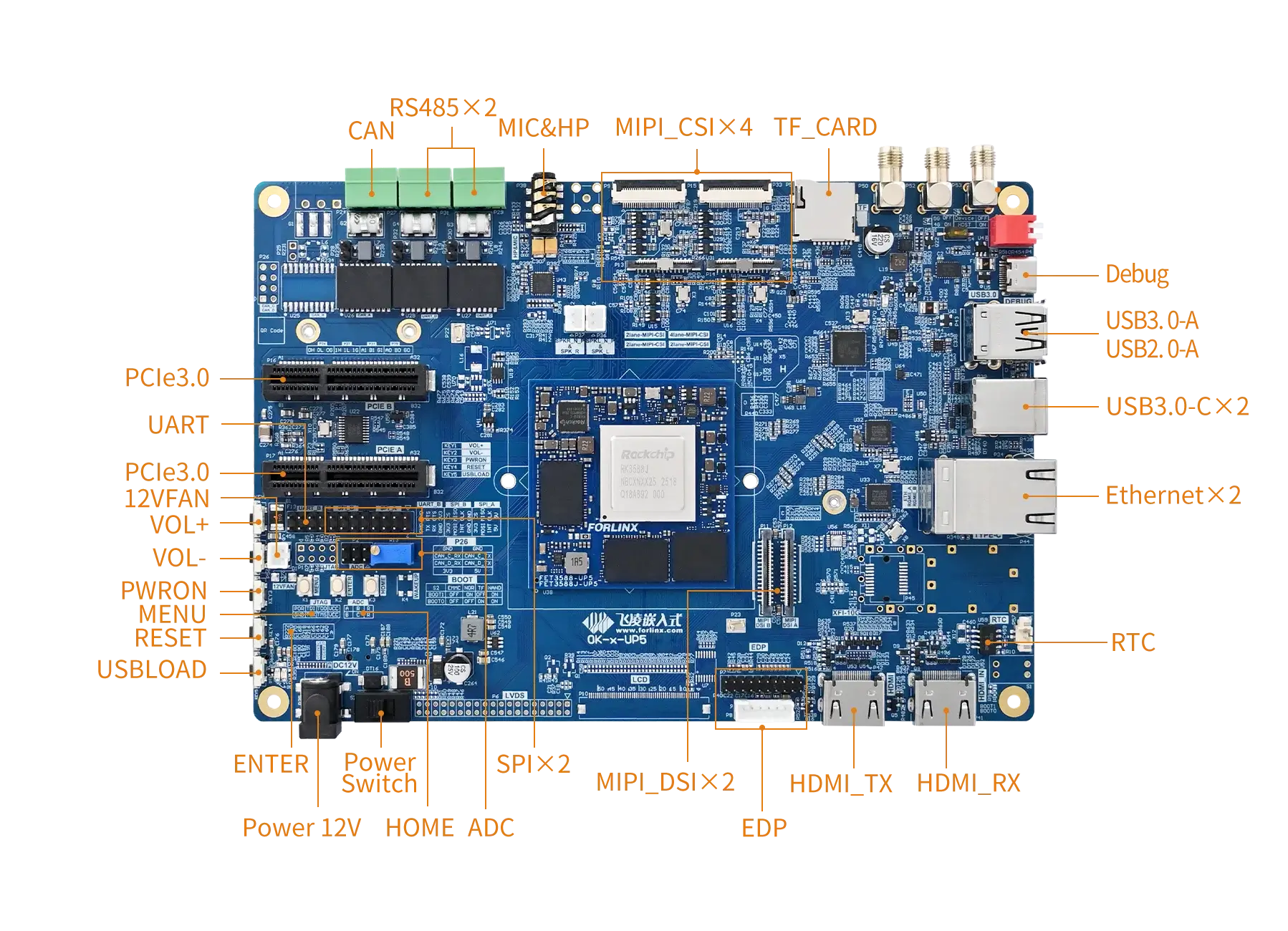
Build Faster with OK3588J-UP5 Development Board
Skip the complexity of hardware design with the OK3588J-UP5 development board. This production-ready platform combines a proven SoM + Carrier architecture, allowing you to bypass low-level circuitry and focus entirely on your application software. Seamlessly transition from initial concept to mass production with minimal risk, rich connectivity, and comprehensive multi-OS support.
▊ Accessories
Please click here to get more information about the supported modules and accessories.
▊ Documentation
Reference Manuals
Hardware Related
Product Datasheet
User Guide
Carrier Board Schematic
Carrier Board PCB
SoM Pinmux
Software & BSP
OS Image
Testing Demo
Source Code
Manual
Request a Quote
Fill out the form below for volume pricing or technical specifications. We'll get back to you within 24 hours.
▊ Ordering Information
1. Online Channels: We have an online store on Alibaba and DigiKey. Please contact us for details.
2. Direct Inquiry: For bulk orders, please email our sales team at [email protected].
3. Payment Method: Standard terms: 100% T/T (Telegraphic Transfer) in advance.
1. Dispatch Method: Orders are shipped via international express upon receipt of payment.
2. Lead Time: 5 working days for samples; 6 weeks for bulk orders.
3. Shipping Policy: Shipping and handling fees are the responsibility of the purchaser.
▊ Forlinx Recommended Products
Architecture: 4x Cortex-A72 + 4x Cortex-A53
Frequency: [email protected][email protected]
RAM: 8GB LPDDR4,2GB/4GB LPDDR4
ROM: 16GB eMMC,32GB/64GB eMMC
Architecture: 4x Cortex-A76+4x Cortex-A55
Frequency: [email protected]/1.6GHz, [email protected]/1.3GHz
RAM: 4GB/8GB/16GB/32GB LPDDR4
ROM: 32GB/64GB/128GB eMMC