

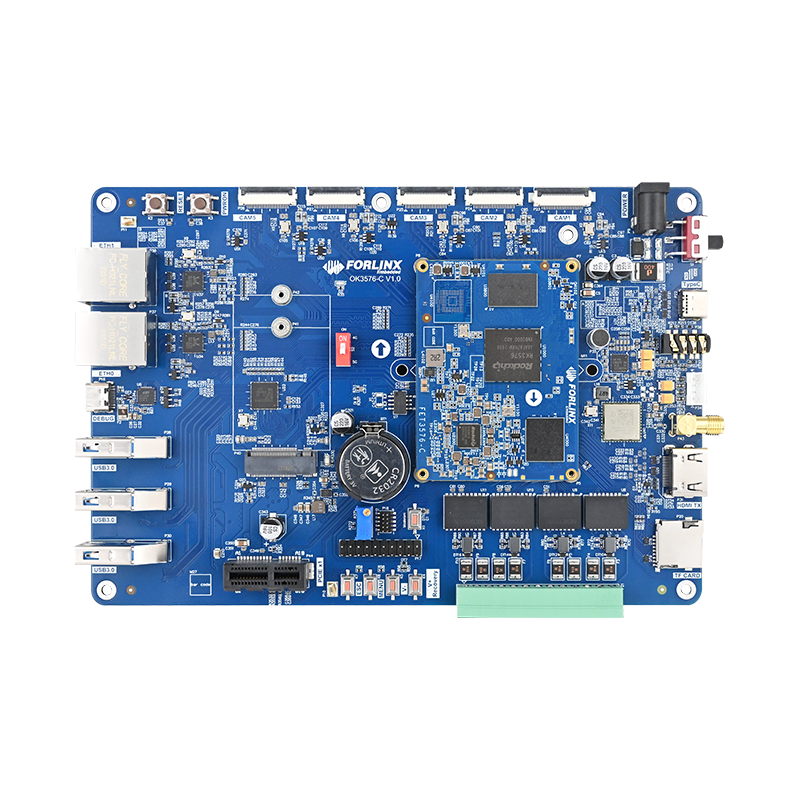
OK3576-C Single Board Computer
CPU: Rockchip RK3576
Architecture: 4x Cortex-A72 + 4x Cortex-A53
Frequency: [email protected][email protected]
RAM: 2GB/4GB LPDDR4
ROM: 32GB eMMC
System: Android14,ForlinxDesktop 24.04,Linux 6.1.57,Linux 6.1.118
OK3576-C Single Board Computer Based on Rockchip RK3576 Processor
Featuring a SoM + carrier board split design and utilizing 4 x 100-pin board-to-board connectors, it effortlessly exposes all processor function pins, optimizing them for various functionalities. Simplify your design process while empowering seamless secondary development. Elevate your projects with the OK3576-C and unlock limitless possibilities for innovation!
OK3576-C SBC
Octa-Core CPU with 8K Video Decoding
RK3576 is a high-performance, low-power AIoT processor from Rockchip. It integrates an octa-core CPU (4×Cortex-A72 + 4×Cortex-A53) and a 6TOPS NPU. The architecture features an embedded 3D GPU and a dedicated 2D hardware engine with MMU for optimized display performance, supporting H.265 8K Ultra HD hardware decoding.
True Hardware Isolation
The RK3576 features a hardware Firewall to manage access permissions between the master and peripherals/memory, ensuring hardware resource isolation. This enhances system stability and security across diverse application scenarios.
6 TOPS NPU for AI Acceleration
6TOPS super-computing power NPU, support INT4/INT8/INT16/FP16/BF16/TF32 operation, support dual-core work together or work independently, support multi-task, multi-scenario parallel, support deep learning frameworks: TensorFlow, Caffe, Tflite, Pytorch, Onnx NN, Android NN, etc.
Ultra Clear Display + AI Intelligent Repair
Supports H.264/H.265 encoding and decoding with five output interfaces: HDMI/eDP, MIPI DSI, Parallel, EBC, and DP. It enables triple-screen independent display at 4K@120Hz, featuring super-resolution and intelligent image enhancement (de-blurring & frame rate upscaling) for diverse scenarios.
New Parallel FlexBus Interface
FlexBus: A flexible parallel interface supporting 2/4/8/16-bit data transmission at up to 100MHz, capable of emulating standard or custom protocols. The RK3576 also integrates extensive connectivity, including DSMC, CAN-FD, PCIe 2.1, SATA 3.0, USB 3.2, SAI, I2C, I3C, and UART.
Rich Ecosystem for Rapid Development
Versatile Applications Across Industries
Targeting Industrial, AIoT, Edge Computing, and Smart Terminals, the FET3576-C offers a versatile platform for digital multimedia.
Backed by Forlinx’s expert technical support, you can accelerate time-to-market and gain a competitive edge in your industry.
RK3576 SoM/SBC Video
Forlinx Launched FET3576 System on Module powered by the Rockchip RK3576 processor
▊ Hardware Features
|
FET3576-C System on Module (SoM) Specifications |
|
|---|---|
|
Processor |
Rockchip RK3576 CPU: Octa-core (4×Cortex-A72 @ 2.2 GHz + 4×Cortex-A53 @ 2.0 GHz) NPU: 6 TOPS (INT8), supports INT4/INT16/FP16/BF16/TF32 GPU: ARM Mali-G52 MC3 VPU: Encoding: H.264, H.265 up to 4K @ 60 fps Decoding: H.264, H.265, VP9, AV1, AVS2 up to 8K @ 30 fps or 4K @ 120 fps |
|
RAM |
2 GB / 4 GB LPDDR4 |
|
ROM |
32 GB eMMC |
|
Power Input |
12V DC |
|
Operating Temp. |
FET3576-C (Commercial): 0°C to +80°C FET3576J-C (Industrial): -40°C to +85°C |
|
Packaging |
Board-to-board connectors (4×100-pin, 0.4 mm pitch, 1.5 mm mating height) |
|
OS Support |
Linux 6.1.118, Linux 6.1.57, Android 14, Forlinx Desktop 24.04 |
|
Dimensions |
50 mm × 68 mm |
|
System Flashing |
USB OTG, TF Card |
|
FET3576-C System on Module Functional Interfaces |
|||
|---|---|---|---|
|
Interface |
QTY |
Specifications & Description |
|
|
HDMI/eDP TX (1) |
1 |
Supports 1× HDMI/eDP TX (multiplexed) HDMI: v2.1, up to 4K @ 120 Hz; RGB/YUV444/YUV422/YUV420 8/10-bit; CEC, ARC, HDCP v2.3/v1.4 eDP: v1.3 compliant |
Built-in 3× VOP, supports up to 3 independent displays |
|
MIPI DSI (1) |
1 |
Supports 1× MIPI DSI-2 TX; D-PHY v2.0 or C-PHY v1.1 D-PHY: 4 lanes; C-PHY: 3 trios; up to 2560×1600 @ 60 Hz Format: RGB (up to 10-bit) |
|
|
Parallel (1) |
1 |
Supports RGB/BT.656/BT.1120; up to 1920×1080 @ 60 Hz Format: RGB (up to 10-bit) |
|
|
EBC (1) |
1 |
Supports E-ink EPD; 16-bit bus width; up to 32 grayscale levels Supports 2560×1920 hard decoding; Direct/LUT/3-window modes |
|
|
DP TX (1) |
1 |
DisplayPort v1.4 via USB Type-C (DP Alt Mode); MST support 1/2/4 lanes at 1.62/2.7/5.4/8.1 Gbps; up to 4K @ 120 Hz Format: RGB/YUV444/YUV422/YUV420 8/10-bit; HDCP v2.3/v1.3 |
|
|
USB 3.2 |
2 |
1× USB 3.2 Gen1 (DRD) supports DP Alt Mode; 1× Combo High-speed interface |
|
|
MIPI CSI |
Up to 5 |
5× CSI-2: 4× 2-lane D-PHY v1.2 (2.5 Gbps/lane), combinable into 2× 4-lane; 1× 4-lane D-PHY v2.0 (4.5 Gbps/lane) or 3-trio C-PHY v1.1 (2.5 Gsps/trio) |
Supports up to 5× CSI concurrent inputs |
|
DVP |
1 |
8/10/12/16-bit DVP; up to 150 MHz clock; supports BT.601/BT.656/BT.1120 |
|
|
SAI (2) |
Up to 5 |
SAI 0/1: 4× TX, 4× RX lanes; SAI 2/3/4: 1× TX, 1× RX lane Supports I2S/TDM/PCM modes; up to 192 kHz / 32-bit resolution |
|
|
SPDIF |
Up to 2 |
Supports 2× TX and 2× RX |
|
|
PDM |
Up to 2 |
Supports up to 8 channels; 16 to 24-bit resolution; up to 192 kHz sampling rate |
|
|
Digital Audio Codec |
1 |
Supports 2× DAC; I2S/PCM Master/Slave modes; 16-bit sampling; Volume control |
|
|
SDIO |
Up to 2 |
SDIO v3.0, 4-bit data bus |
|
|
Ethernet |
Up to 2 |
2× GMAC (RGMII/RMII); 10/100/1000 Mbps |
|
|
USB 2.0 OTG |
2 |
Supports Host and Device modes |
|
|
Combo High-Speed Interface |
2 |
Combo 1: PCIe 2.1 (5 GT/s) / SATA 3.1 (6 GT/s) Combo 2: PCIe 2.1 / SATA 3.1 / USB 3.2 Gen1 (5 Gbps) PCIe: RC mode only; SATA: AHCI v1.3.1; USB: DRD (xHCI Host up to 64 devices) |
|
|
UART |
Up to 12 |
Up to 4 Mbps; 64-byte FIFO; supports flow control and RS485 |
|
|
CAN-FD |
Up to 2 |
CAN 2.0 and CAN-FD compliant; standard/extended frames; 8192-bit FIFO |
|
|
DSMC |
Up to 1 |
8/16-bit bus; up to 4 chip selects; 16/32-bit configurable address width |
|
|
FlexBus |
Up to 1 |
Flexible parallel bus; supports DMA, ping-pong buffering, and continuous mode |
|
|
SPI |
Up to 5 |
Master/Slave modes; each supports up to 2 chip selects |
|
|
I2C |
Up to 9 |
7/10-bit addressing; Standard (100 kbps) and Fast (400 kbps) modes |
|
|
I3C |
Up to 2 |
Supports MIPI I3C v1.1 |
|
|
PWM |
Up to 16 |
Supports capture mode and interrupt operations |
|
|
ADC |
Up to 8 |
12-bit SAR-ADC; sampling rate up to 1 MS/s |
|
|
GPIO |
/ |
Supports interrupt generation (edge/level); configurable pull-up/pull-down and drive strength |
|
Note(1) Video Port
Video Port0: up to 4K@120Hz, 10 bits;
Video Port1: up to 2560x1600@60Hz, 10 bits;
Video Port2: up to 1920x1080@60Hz, 8 bits
Each interface can be connected to HDMI/eDP/DSI-2
Port1 and Port2 can be connected to serial output interface
Note(2): single TDM clock up to 50MHz, when working with TDM mode, it can work together with audio sampling frame rate and resolution to compute supported audio channels
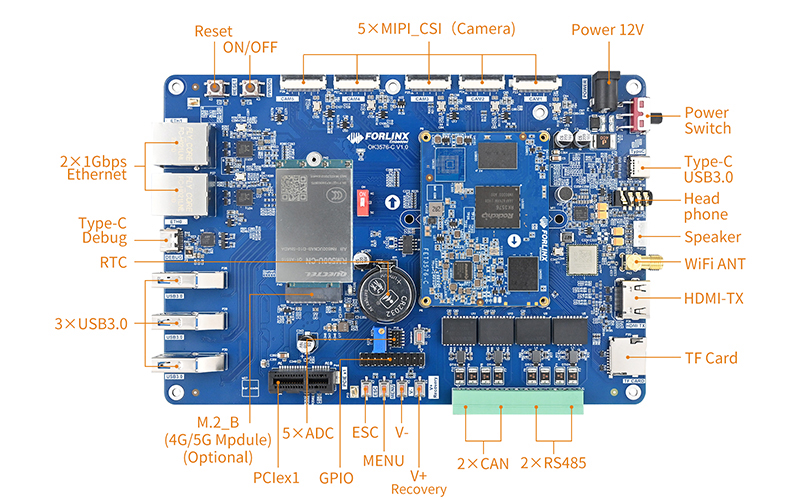
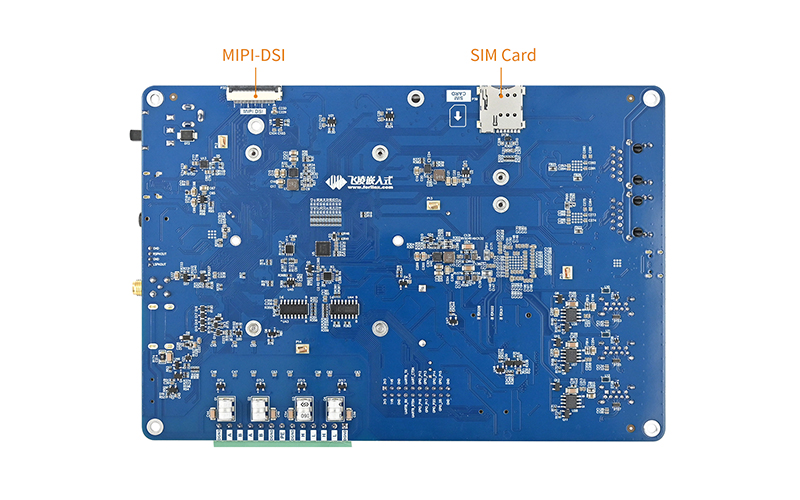
▊ OK3576-C Carrier Board (SBC)
|
|
| OK3576-C Single Board Computer (SBC) Peripheral Features | |||
|---|---|---|---|
|
Peripheral Interface |
QTY |
Specifications & Description |
|
|
HDMI TX |
1 |
Standard Type-A, HDMI v2.1, up to 4K @ 120 Hz |
|
|
MIPI DSI |
1 |
4-lane output, up to 2560×1600 @ 60 Hz; Default: 7-inch MIPI LCD (1024×600) |
|
|
DP TX |
1 |
DisplayPort v1.4 via USB Type-C (multiplexed with USB 3.1), up to 4K @ 120 Hz |
|
|
HDMI RX |
1 |
Standard HDMI Input, up to 4K @ 60 Hz (RK3576 supports up to 4K) |
|
|
USB 3.1 Gen1 |
1 |
USB Type-C connector, supports DRD and DP Alt Mode |
|
|
MIPI CSI |
5 |
1× MIPI D-PHY v2.0 (4 lanes, 4.5 Gbps/lane), FPC-26P, supports OV13850 4× MIPI D-PHY v1.2 (2 lanes, 2.5 Gbps/lane), FPC-26P, supports OV5645 |
|
|
Audio |
1 |
On-board Codec; 3.5 mm Jack (Phone+MIC) and Speaker header |
|
|
TF Card |
1 |
Supports SDR104 mode, clock up to 150 MHz |
|
|
Ethernet |
2 |
2× RJ45, 10/100/1000 Mbps self-adaptive |
|
|
4G/5G |
1 |
M.2 Key-B slot for cellular modules |
|
|
WiFi & BT |
1 |
AW-CM358SM module, Dual-band WiFi (2.4G/5G) and Bluetooth 5.0 |
|
|
USB 3.0 Host |
3 |
3× USB Type-A, supports SuperSpeed (5 Gbps), HS, FS, and LS modes |
|
| PCIe 2.0 |
1 |
PCIe x1 slot, up to 5 GT/s |
|
|
UART |
1 |
Debug UART, 2.54 mm pitch header, up to 4 Mbps |
|
|
CAN-FD |
2 |
2× CAN-FD with on-board transceivers |
|
|
RS485 |
2 |
On-board transceivers with isolation (optional) |
|
|
ADC |
5 |
1.27 mm pitch header, 12-bit resolution, up to 1 MS/s |
|
|
RTC |
1 |
On-board RTC with CR1220 battery holder |
|
|
GPIO |
8 |
2.54 mm pitch header; supports 1.8V/3.3V/5V power output |
|
▊ Accessories
Please click here to get more information about the supported modules and accessories.
▊ Documentation
Reference Manuals
Hardware Related
Product Datasheet
User Guide
Carrier Board Schematic
Carrier Board PCB
SoM Pinmux
Firmware Related
OS Image
Testing Demo
Source Code
Manual
Request a Quote
Fill out the form below for volume pricing or technical specifications. We'll get back to you within 24 hours.
▊ How To Buy & Shipment
1. Order Online: We have an online store on Alibaba. Please contact us for details.
2. Order Offline: Send your inquiry to [email protected].
3. Payment Terms: 100% T/T in advance.
1. Delivery: Goods shipped by express upon receipt of payment.
2. Lead Time: Sample orders within 5 working days; bulk orders 6 weeks.
3. Shipping Charge: Buyers bear the shipping cost.
▊ Standard Packing List
▊ Forlinx Recommended Products
Architecture: 4x [email protected]
Frequency: 1.3GHz,1.6GHZ
RAM: 1GB/2GB/4GB LPDDR4
ROM: 8/16/32/64GB eMMC
Architecture: 4x Cortex-A76+4x Cortex-A55
Frequency: [email protected]/1.6GHz, [email protected]/1.3GHz
RAM: 4GB/8GB/16GB LPDDR4x
ROM: 32GB/64GB/128GB eMMC
Architecture: 4x Cortex-A72+4x Cortex-A53
Frequency: [email protected][email protected]
RAM: 2GB/4GB LPDDR4
ROM: 32GB eMMC
Architecture: Cortex-A55
Frequency: 1.8GHz,2.0GHz
RAM: 1GB/2GB/4GB/8GB DDR4
ROM: 8/16/32/64GB eMMC