
Choosing Your RV1126B SoM: A Clear Guide Stamp-hole vs. Bord-to-board: Which is Best for Your Project?
As AI and edge computing accelerate, the Rockchip RV1126B series has become the go-to solution for demanding applications like industrial vision, smart security, and IoT. It combines formidable 3 TOPS compute power with industrial-grade robustness and compelling value, delivering the performance and reliability these fields require.
Forlinx Embedded has launched two system-on-modules (SoMs), the FET1126B-S and FET1126B-C, based on the same chipset but designed for different applications.
Many engineers face the same questions during selection: Do both modules offer the same performance? What are the key differences? Which one is the right fit for my project? Today, we’ll break down the distinctions across four key dimensions—core configuration, package form factor, functional features, and target applications—to help you make the perfect match for your needs.
1. Common-Core Platform with Identical Foundational Capabilities
Both SoMs are built on the Rockchip RV1126B/RV1126BJ processors. They share identical core computing power, vision processing capabilities, industrial-grade reliability, and software ecosystem, providing a universal hardware foundation for edge AI applications.
Tier-Equal Computing and Vision Capabilities
Equipped with an independent 3 TOPS @ INT8 NPU that supports INT8/INT16 mixed-precision operations, it can efficiently run typical edge AI models — including face detection, safety helmet identification, fire/smoke alarm, and area intrusion detection — delivering real-time local inference without cloud dependency.
Integrating AI-ISP and a dedicated VPU, the modules support 8MP@30fps image processing, 4K@30fps H.264/H.265 hardware encoding/decoding, and dual MIPI-CSI camera inputs, catering to multi-channel vision analysis requirements.
Industrial-Grade Wide-Temperature Reliability
The commercial-grade version operates at -20℃ to +85℃, while the industrial-grade version covers -40℃ to +85℃. Combined with wide-temperature LPDDR4 memory and eMMC storage, both can withstand harsh environments such as complex industrial sites and outdoor installations.
Complete and Unified Software Ecosystem
Both modules run on Linux 6.1 and come with full BSP support, including kernel source code, drivers, file systems, and the RKNN toolchain. They are compatible with model conversion from mainstream deep learning frameworks such as TensorFlow, PyTorch, and Caffe, ensuring consistent development experience and seamless project migration.
Fully Exposed Interface Resources
All functional pins of the processor are fully exposed, offering a rich set of industrial interfaces — including display, Gigabit/Fast Ethernet, CAN-FD, UART, SPI, and ADC. GPIO pins are compatible with the Raspberry Pi 40-pin standard, enabling flexible peripheral expansion.
2. Three Core Differentiators to Match Various Project Requirements
The essential differences between the two products lie in the packaging connection method, physical form factor, and low-power characteristics — each corresponding to different project stages and application scenarios.
Connection Method: Soldered Mounting vs. Socketed Connection
This is the most fundamental structural difference between the two products, which directly determines mass production processes and maintenance efficiency.
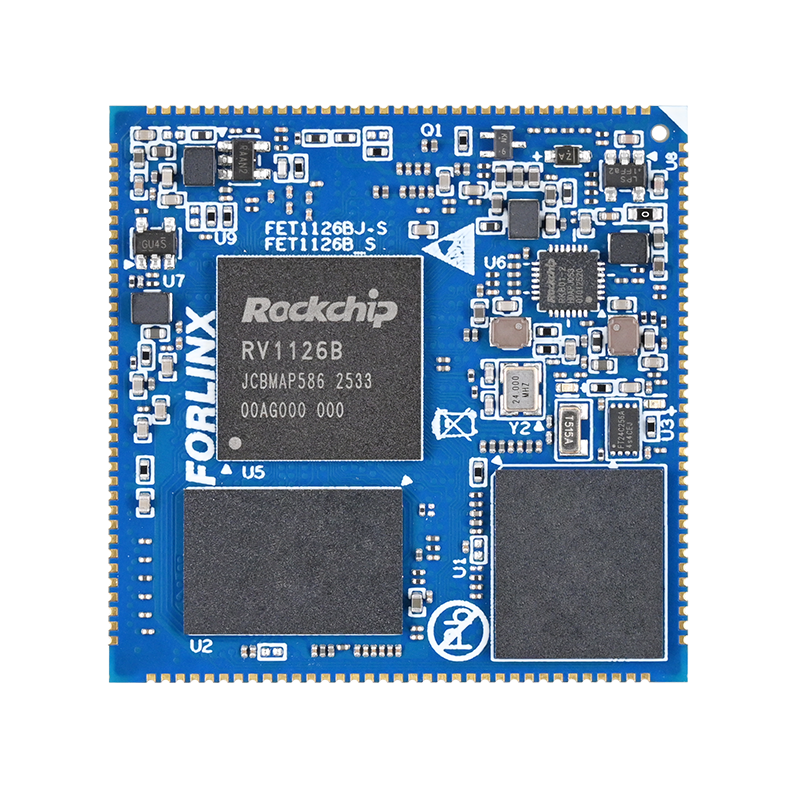
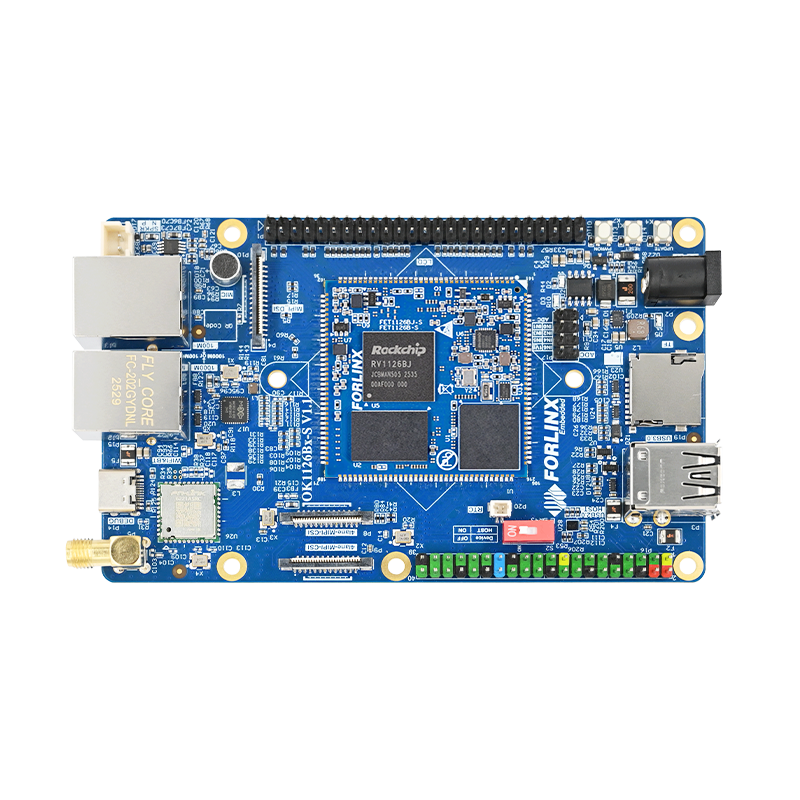
FET1126B-S: Stamp Hole + LGA Hybrid Soldering
140 stamp hole pins + 97 LGA pads, totaling 237 functional pins, are attached to the carrier board via soldering.
Advantages: Robust connection with excellent resistance to vibration and shock. Lower per-unit production cost in batch soldering. Ideal for mass production after the design is finalized.
FET1126B-C: Board-to-Board Connector Plug-in Type
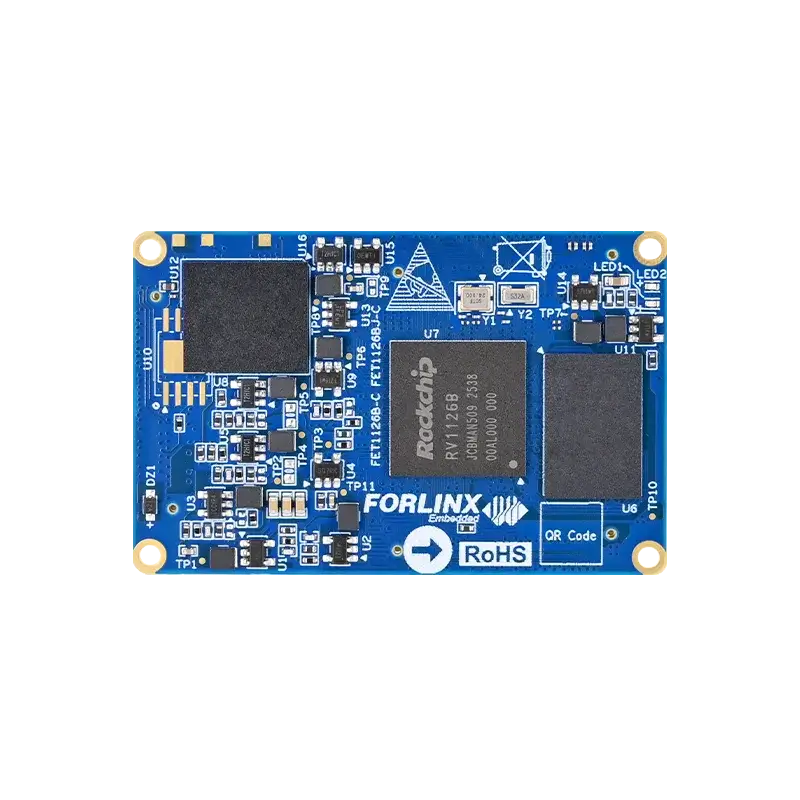
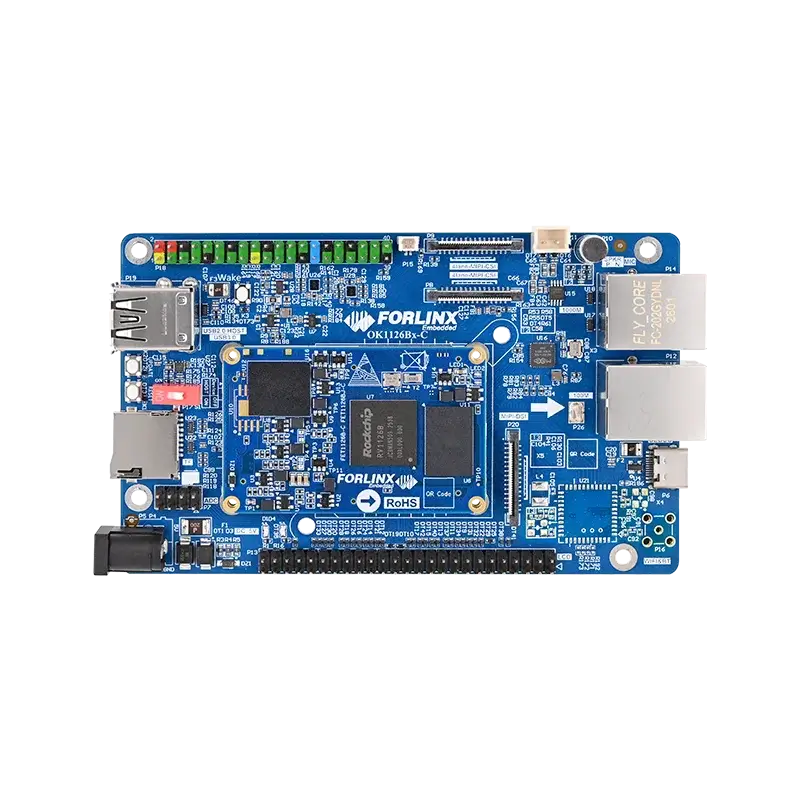
3 sets of ultra-thin 80Pin board-to-board connectors (total 240 pins) with a pitch of 0.5mm and a combined mating height of only 2.0mm, connecting to the carrier board via a latching mechanism.
Advantages: Supports hot-swapping and replacement. Facilitates R&D debugging, fault repair, and version upgrades without desoldering, significantly improving development iteration efficiency.
Form Factor: 40×40mm Square vs. 56×36mm Rectangle
Both are compact size System-on-Modules (SoMs), but their different shapes cater to distinct device structural designs.
FET1126B-S SoM: Features a 40mm × 40mm square design with a compact and symmetrical layout. Better suited for end devices with regular internal space and facilitates PCB thermal management and structural arrangement.
FET1126B-C SoM: Features a 56mm × 36mm rectangle design with board-to-board connectors arranged along the long side. More adaptable to elongated or space-constrained device housings. The plug/unplug operation aligns better with typical device assembly/disassembly workflows.
Power Consumption: Standard Industrial Grade vs.Ultra-Low Power Always-On Sensing
AOA/AOV ultra-low-power standby is an exclusive feature of the FET1126B-C and represents the most critical functional difference between the two products.
FET1126B-S: Designed for standard operating power consumption, meeting the needs of continuously powered industrial equipment.
FET1126B-C: Supports AOA (Always On Audio) for continuous audio capture and AOV (Always On Video) for video pre-detection, enabling persistent sensing and monitoring even when the main system is in sleep mode.
In AOV standby mode, power consumption is as low as 0.007W.
Supports remote wake-up via Wi-Fi or 4G signals.
Enables 7×24 hours of uninterrupted sensing.
Particularly suitable for battery-powered, unattended low-power scenarios.
3. Key Parameter Comparison Quick-Reference Table
For easy and quick comparison, the core parameter differences between the two SoMs:
| Item | FET1126B-S SoM | FET1126B-C SoM |
| Processor |
RV1126B/RV1126BJ 4×Cortex-A53 |
RV1126B/RV1126BJ 4×Cortex-A53 |
| NPU computing power | 3TOPS@INT8 | 3TOPS@INT8 |
| Connection | Stamp Hole + LGA Hybrid Soldering (Total 237 pins) | Board-to-Board Connector Plug-in (3×80Pin, 240 pins total) |
| SoM Dimensions | 40mm×40mm square | 56mm×36mm rectangle |
| AOA/AOV Low Power | Not Supported | Supported (Standby power as low as 0.007W) |
| Operating Temperature | -20℃~+85℃ / -40℃~+85℃ | -20℃~+85℃ / -40℃~+85℃ |
| Memory/Storage | 1/2/4GB LPDDR4;8/16/32/64GB eMMC | 1/2/4GB LPDDR4;8/16/32/64GB eMMC |
| Key Advantages | Robust connection, excellent vibration resistance, optimized production cost | Easy plug/unplug, easy maintenance, ultra-low-power always-on sensing |
| Application Phase | Mass production | R&D/Prototyping phase + Low-power scenarios |
4. Selection Guide: Match the Product to Your Application Scenario
Prioritize the FET1126B-S SoM
The product design is finalized and entering the mass production phase, where optimizing BOM cost is a priority.
For equipment requiring high reliability and strong resistance to vibration, such as industrial control terminals, smart gate systems on construction sites, and industrial gateways.
For continuously powered scenarios with no requirement for ultra-low-power always-on sensing.
For projects where the SoM is not expected to be frequently replaced throughout the product lifecycle.
Prioritize the FET1126B-C SoM
The project is in the R&D and prototyping phase, requiring frequent hardware debugging and iterations.
For battery-powered portable monitoring devices, low-power security terminals, and unattended monitoring stations demanding long battery life.
For applications requiring 7×24 hours low-power sensing and remote wake-up capability.
For equipment with high post-deployment maintenance needs, where quick SoM replacement is desired to reduce operational and maintenance costs.
A combination strategy is also viable: use the board-to-board connector version for R&D/prototyping and the stamp hole version for mass production. This enables a smooth transition from development to production, balancing development efficiency with volume manufacturing cost.
Forlinx Embedded’s FET1126B-S and FET1126B-C SoMs are not tiered high/low configurations but differentiated solutions on the same platform, tailored for different project phases and application scenarios:
- The Stamp Hole version focuses on production reliability and cost optimization.
- The Board-to-Board Connector version focuses on R&D efficiency and low-power features.
Both products share a complete software ecosystem and technical support. Developers can flexibly select the model that best fits their project’s specific requirements. To obtain the full datasheets for both SoMs or to request development samples, please contact our sales team.