


FET1126Bx-C System on Module
CPU: Rockchip RV1126B/RV1126BJ
Architecture: 4x [email protected]
Frequency: 1.3GHz,1.6GHZ
RAM: 1GB/2GB/4GB LPDDR4
ROM: 8/16/32/64GB eMMC
System: Linux 6.1
Rockchip RV1126B / RV1126BJ System-on-Module | 3 TOPS Edge AI SoM
Accelerate your Edge AI and machine vision projects with the Forlinx FET1126B-C/FET1126BJ-C System on Module/Computer on Module. Featuring the Rockchip RV1126B/BJ, this industrial-grade SoM delivers 3 TOPS NPU compute, ultra-low power AOV, and 10-15 years of guaranteed availability. Ideal for smart security, industrial IoT, and edge analytics.
Highlights:
- 3 TOPS Edge AI: Quad-core Cortex-A53 with dedicated NPU, enabling localized object detection and RKNN support.
- Ultra-Low Power (AOV): Always-On Video/Audio achieves 0.007W in sleep+camera mode for battery-powered devices.
- Advanced 4K Vision: Built-in AI ISP and VPU for parallel H.264/H.265 hardware encoding/decoding and dual MIPI-CSI.
- Industrial Grade & Longevity: Wide operating temps (-40°C to +85°C for RV1126BJ) with a 10-15 year supply guarantee.
- Compact & I/O Rich: 36mm × 56mm footprint exposing RGMII, CAN FD, UART, and SPI via reliable connectors.
- Production-Ready BSP: Linux 6.1.141 support with complete hardware files and ready-to-test AI algorithms.
FET1126BJ-C SoM
3TOPS NPU | Edge AI | AOA+AOV Support | 10-15 Year Longevity
Functional Diagram
Robust Vision Engine for Multi-Stream Analysis
Compared to the RV1126, it offers three major enhancements: boosted CPU and NPU performance, plus an upgraded OS. Enjoy a more powerful, intelligent, and seamless device AI journey.
FET1126B‑C / FET1126BJ‑C SoM
Designed in an ultra-compact footprint (56 × 36 mm), the FET1126B-C/FET1126BJ-C SoM uses three 80-pin board-to-board connectors (240 pins total; 0.5 mm pitch, 2.0 mm mated height) for reliable assembly.
All RV1126B/RV1126BJ I/Os—camera, display, audio, Ethernet, and serial buses—are fully accessible, enabling flexible carrier-board expansion and custom development.
▊ Hardware Features
| FET1126Bx-C SoM Parameters | ||
|---|---|---|
| Processor | Rockchip RV1126B | Rockchip RV1126BJ |
| CPU: 4×Cortex-A53, up to 1.6GHz | CPU: 4×Cortex-A53, up to 1.3GHz | |
| NPU: 3 TOPS@INT8 | ||
| GPU: No 3D GPU; supports 2D RGA only | ||
|
ISP: VICAP input: RX raw8/raw10/raw12/raw14/raw16 Maximum input: 12M@20fps Minimum input: 264x264 |
||
|
AI ISP: Maximum input: 8M@30fps Maximum Resolution: 4096 x 4096 |
||
|
VPU Video Decoder: - Supports H.264 and H.265 hardware decoding - H.265 HEVC/MVC Main Profile [email protected] up to 3840x2160@30fps - H.264 AVC/MVC Main Profile yuv400/yuv420/[email protected] up to 3840x2160@30fps VPU Video Encoder: - Supports HEVC, H.264 and JPEG hardware encoding - Supports parallel encoding (HEVC+JPEG or H.264+JPEG) - Supports up to 12M@30fps JPEG decoder: - Supported image resolutions: 48x48 to 65520x65520 - Supports YUV400/YUV420/YUV422/YUV440/YUV411/YUV444 |
||
| RAM | 1GB/2GB/4GB LPDDR4 | |
| ROM | 64GB eMMC | 8GB/16GB/32GB/64GB eMMC |
| Operating Temperature | -20℃ ~ +85℃ | -40℃ ~ +85℃ |
| Operating Voltage | DC 5V | |
| OS | Linux 6.1.141 | |
| Flashing | USB OTG, TF | |
| Connection | Ultra-thin board-to-board connector (3*80pin, 0.5 mm pitch, total height 2.0 mm) | |
| FET1126Bx-C SoM Function Parameters | ||
|---|---|---|
| Function | Quantity | Parameter |
| Display | 1 |
Supports 1 x display output, with a maximum resolution of 1920*1080@60fps Supports various display interfaces: - RGB: 24bit - MIPI-DSI: 4lane, 1.5Gbps/lane - BT.656/BT.1120 |
| MIPI CSI | ≤2 |
Supports 2 x 4lane, 2.5Gbps/lane - Supports two MIPI CSI/LVDS/SubLVDS DPHYs - Each MIPI DPHY V1.2, 4lane, 2.5Gbps/lane - Each interface can be configured as a 2x2 data channel port - Virtual channels are supported |
| DVP | 1 |
Supports 8/10/12/14/16-bit, with an I/O frequency of up to 150 MHz Supports BT.601/ BT.656 and BT.1120 Input |
| Ethernet | 1 | 1 x MAC, which can be used for either one RGMII interface or one 100 Mbit/s interface (the CPU has one integrated 100 Mbit/s PHY) |
| USB | 2 |
1 x USB 2.0 Host 1 x USB 2.0/3.0 DRD |
| UART | ≤8 | The maximum supported baud rate is 4 Mbps; UART1–UART7 support automatic flow control. |
| CAN | ≤2 | Supports CAN2.0/B |
| SDIO 3.0 | ≤2 | 1 x TF card slot, supporting high-speed cards; 1 x SDIO interface, 3.3V logic level |
| DSMC | ≤1 |
1 x host interface, which can be used to connect to an FPGA Supports 4 chip-select signals and 8-wire or 16-wire serial transmission modes |
| FSPI | ≤1 | Supports boot-up; 1/2/4-bit modes |
| SPI | ≤2 | Configurable master-slave mode |
| I2C | ≤5 | Supports 7bits and 10bits address modes up to 1 Mbit/s |
| PWM | ≤27 | Supports up to 27 channels of PWM. |
| ADC | ≤24 | 24 single-ended inputs, 13bit, 2 MSPS |
| SAI | ≤3 | Configurable master-slave mode |
| Audio ADC | ≤2 | 2 x differential MIC inputs, 2 x Audio DSM differential outputs |
| GPIO | ≤118 | The total quantity excluding the internal use of the SoM |
Note*: Note: The parameters in the table are based on hardware design or theoretical CPU values.
▊ Carrier Board
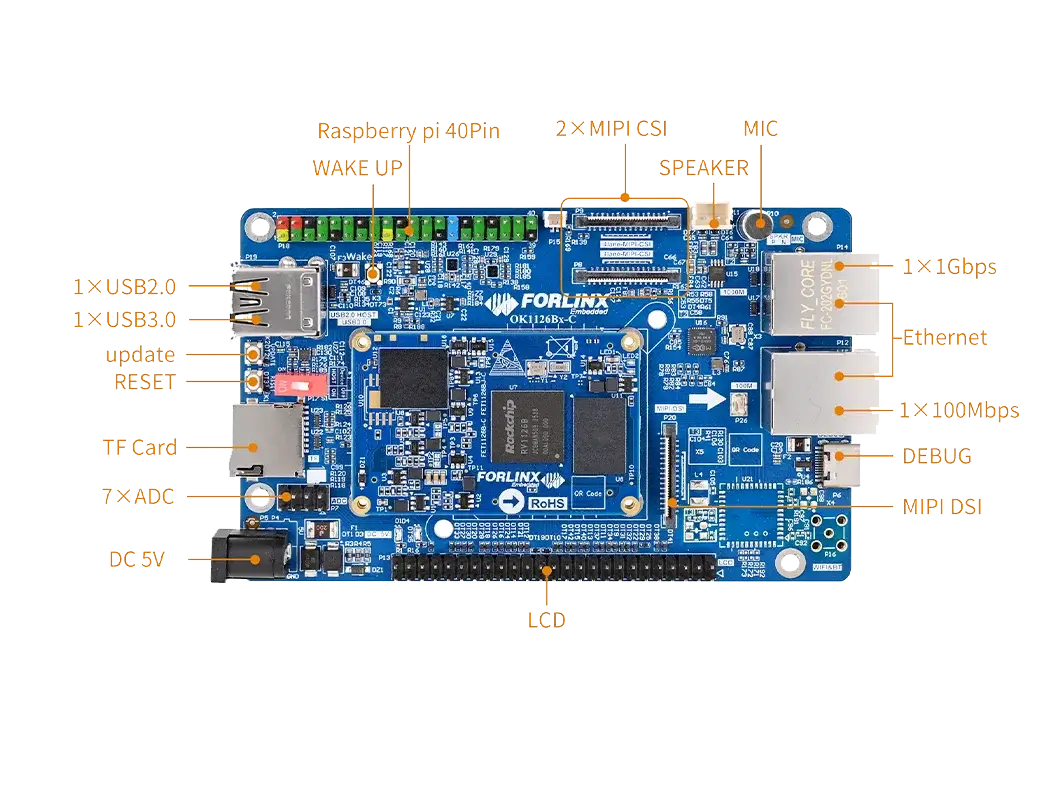
Build Faster with OK1126Bx-C Development Board
Skip the complexity of hardware design with the OK1126Bx-C development board. This production-ready platform combines a proven SoM + Carrier architecture, allowing you to bypass low-level circuitry and focus entirely on your software. Seamlessly transition from initial concept to mass production with minimal risk and comprehensive Linux support.
| OK1126Bx-C Development Board Function Parameters | ||
|---|---|---|
| Function | Quantity | Parameter |
| TF Card | 1 | Data rate up to SDR104; |
| KEY | 3 | CPU Reset, Boot Options and Wake-up Button |
| UART Debug | 1 | Integrated into a single Type-C port, enabling connection to a PC for debugging. |
| USB2.0 | 2 | 1 x USB_HOST port is connected via a USB socket; 1 x USB_OTG port is connected via a Type-C connector for use with OTG programming or, when combined with USB 3.0, via a USB 3.0 socket. |
| USB3.0 | 1 | The USB 3.0 host is connected to the USB 3.0 socket. |
| WiFi Bluetooth (1) | 1 |
Single antenna 2.4G&5GHz Wi-Fi Dual-band 1X1 802.11ac + Bluetooth 4.2 |
| SPI | 1 | SPI1 is routed out via the Raspberry Pi’s 40PIN header |
| RTC | 1 | Powered by an external CR2032 button cell; data retention time when power is off |
| Ethernet | 1 | Featuring a standard RJ45 socket, with either a 100 Mbps port or a 1 Gbps port, the RV1126B is equipped with a single GMAC controller. This allows it to provide RMII/RGMII interfaces for connecting external 100 Mbps or one Gbps Ethernet PHY chips, or to switch to the built-in 100 Mbps FEPHY. Only one of these options can be selected at a time; they cannot be used simultaneously. |
| UART | 1 | UART5 is routed out via the Raspberry Pi’s 40PIN header |
| I2C | 2 | I2C3 and I2C4 are connected via the Raspberry Pi’s 40PIN header |
| SPEAKER | 1 | Through the power amplifier chip, it can be connected to an external 4Ω–3.3W speaker. |
| MIC | 2 | One channel is connected to the onboard electret microphone, and the other channel is not externally accessible. |
| ADC | 7 | 7 x ADC are routed out via pin headers. |
| MIPI-CSI | 2 | Routed out via an FPC connector, 4 lanes + 4 lanes. |
| LCD | 1 | Routed out via pin headers, supports capacitive touch screens. |
| MIPI_DSI | 1 | 4-lane MIPI-DSI, supports capacitive touch screens |
Note: The parameters in the table are based on hardware design or theoretical CPU values.WiFi/Bluetooth is currently not supported in this version; the carrier board circuit can be referenced.
▊ Accessories
Please click here to get more information about the supported modules and accessories.
▊ Documentation
Reference Manuals
Hardware Related
Product Datasheet
User Guide
Carrier Board Schematic
Carrier Board PCB
SoM Pinmux
Software & BSP
OS Image
Testing Demo
Source Code
Manual
Request a Quote
Fill out the form below for volume pricing or technical specifications. We'll get back to you within 24 hours.
▊ Ordering Information
1. Online Channels: We have an online store on Alibaba and DigiKey. Please contact us for details.
2. Direct Inquiry: For bulk orders, please email our sales team at [email protected].
3. Payment Method: Standard terms: 100% T/T (Telegraphic Transfer) in advance.
1. Dispatch Method: Orders are shipped via international express upon receipt of payment.
2. Lead Time: 5 working days for samples; 6 weeks for bulk orders.
3. Shipping Policy: Shipping and handling fees are the responsibility of the purchaser.
▊ Forlinx Recommended Products
Architecture: 4x [email protected]
Frequency: 1.6GHZ
RAM: 2GB/4GB
ROM: 16GB/64GB eMMC
Architecture: 4x [email protected]
Frequency: 1.3GHz,1.6GHZ
RAM: 1GB/2GB/4GB LPDDR4
ROM: 8/16/32/64GB eMMC
Architecture: 2x [email protected] + 6x [email protected]
Frequency: [email protected],[email protected]
RAM: 2GB / 4GB / 8GB LPDDR5
ROM: 64GB eMMC