
Forlinx Qualcomm Dragonwing IQ9075: Text-to-Image Search by Description at electronica 2026
A local text-to-image search flow on the Qualcomm Dragonwing IQ9075. Four USB cameras feed YOLO26 detection and SigLIP2 encoding into a local vector database, so detected targets can be retrieved later by text description without sending data off the device.
The 2026 edition of electronica in Munich concluded after November 13, where Forlinx exhibited several product solutions and received a warm response. One of them explored local image search on the Qualcomm Dragonwing IQ9075, turning detected camera targets into a searchable on-device index. This piece walks through how detection, encoding and text-based retrieval fit together, and what matters when reviewing the results.
A camera archive is useful only if a user can find the relevant image. Time and camera filters help when the operator knows when and where an event happened. They are less useful when the operator remembers an appearance, such as a red shirt and a backpack. Forlinx demonstrates a local search workflow that connects text descriptions with captured target images on a Qualcomm IQ-9075-based platform.
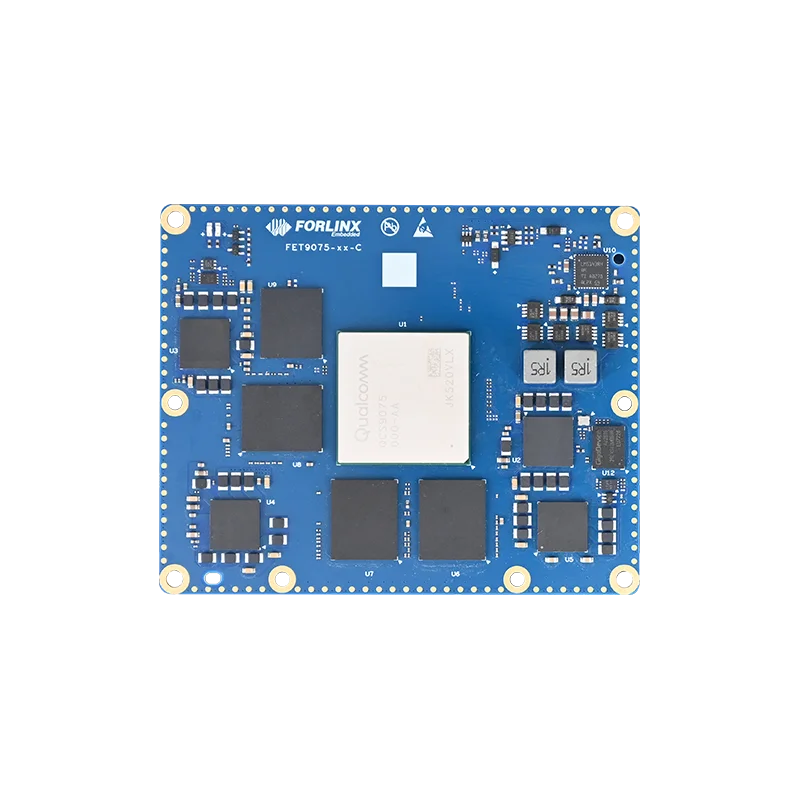
The corresponding FET9075AA-C module was presented in a 100 dense TOPS configuration. The application detects and tracks people, encodes their images with SigLIP2 and builds a local feature index. A typed description is compared with the indexed features to rank candidate images. Capture, indexing and retrieval run locally.
Solution configuration at a glance
According to the solution brief, the IQ9075 flow uses four USB cameras for real-time capture, YOLO26 for object detection and tracking, SigLIP2 image encoding to vectorise each target, and a local vector database for feature storage. A text query is encoded and matched against the stored features by vector similarity, returning candidate images sorted by similarity.
The brief lists personnel retrieval across exhibition zones and industrial parks, security deployment with trajectory traceability and smart-store passenger-flow analysis as typical applications. It cites 100 TOPS of edge computing power, fully local cross-modal retrieval and an edge-side feature library with no data egress. The 100 dense TOPS figure quoted above comes from the module shown at the booth; retrieval quality still depends on the encoder, index and capture set.
Separate indexing from the user query
The indexing path prepares the collection before a user searches it. Detection identifies targets, tracking connects observations, and image encoding produces features for matching. The query path encodes the user's words and compares them with that collection. SigLIP2 is a vision and language encoder family with image and text retrieval capabilities.
This separation explains both the opportunity and the boundary. The application can retrieve images that were detected and indexed. It does not establish that every object in every stored frame can be found. Search behavior depends on the target selection, encoder, index and available images.
Design an interface for useful review
A list of visually similar results should help an operator inspect evidence. For a production design, useful additions to evaluate include capture time, source camera and a link to the original image. They can be included in the interface requirements for a product evaluation.
A query can be revised when the first set of results is too broad. Removing an ambiguous attribute or adding a visible object can change the ranking. The system is matching appearance and language; a high similarity score is not proof of a person's identity or proof that an event occurred.
Define retention and quality together
Local deployment lets a team decide where the image index is stored and how it is managed. Storage planning should account for retained images, feature records and metadata. Retention length affects both capacity and the number of candidates to search. Index maintenance and model updates should also be included in the design.
A useful evaluation set should include relevant targets, visually similar distractors and queries with no correct match. Measure retrieval usefulness as well as query response time. Test occlusion, motion blur and changes in illumination. Peak compute performance does not by itself establish search quality or the maximum archive size.
A description driven archive review task
Consider a reviewer who remembers an appearance but not the capture time. A trial can build an index from an authorized recording and ask the reviewer to find a person using a visible attribute. The candidate list is then checked against the known recording. Repeating the task with different wording shows how retrieval behavior changes.
This is a useful way to assess the solution's advantage: a text query becomes an entry point into the image collection. The test can compare the usefulness of the ranked candidates with conventional browsing without claiming a fixed time saving in advance. It also reveals whether important appearances were missing from the index.
Develop a search brief with Forlinx
Bring example search descriptions, the intended target types and the required retention period to our team. We can discuss the FET9075AA-C platform and the indexing workload around those requirements. A representative capture set lets the project evaluate retrieval usefulness alongside storage and response behavior.
Frequently Asked Questions
What is the full chain for text-based image search on the IQ9075?
According to the solution brief, four USB cameras capture video in real time, YOLO26 performs detection and tracking, SigLIP2 encodes each target into a vector, and a local vector database stores the features. A text query is then matched by vector similarity, returning candidate images sorted by similarity.
Which model encodes both images and text?
SigLIP2 is a vision and language encoder family with image and text retrieval capabilities. It is used both to vectorise captured targets and to encode the user's text query.
How much edge computing power does the IQ9075 provide?
The brief cites 100 TOPS of edge computing power. The 100 dense TOPS figure quoted in the article comes from the module shown at the booth; retrieval quality still depends on the encoder, index and capture set.
Does the image data leave the device?
The retrieval is described as fully local cross-modal search with an edge-side feature library and no data egress. The image collection and its vectors stay on the device.
What applications are listed for text-to-image search?
Typical applications include personnel retrieval across exhibition zones and industrial parks, security deployment with trajectory traceability and smart-store passenger-flow analysis.