
RV1126B Fisheye Panoramic Stitching and Intelligent Recognition Solution
The Forlinx RV1126B reference design combines video from four AHD fisheye cameras into a single 360° panorama. A YOLOv8 model detects people in the stitched image.
When an operator monitors several separate camera feeds, it can be difficult to follow someone moving from one field of view to the next. A single panoramic view allows the operator to see where a person has been detected in relation to the equipment and its surroundings. Forlinx demonstrated this setup at electronica 2026 in Munich.
Camera inputs and video processing
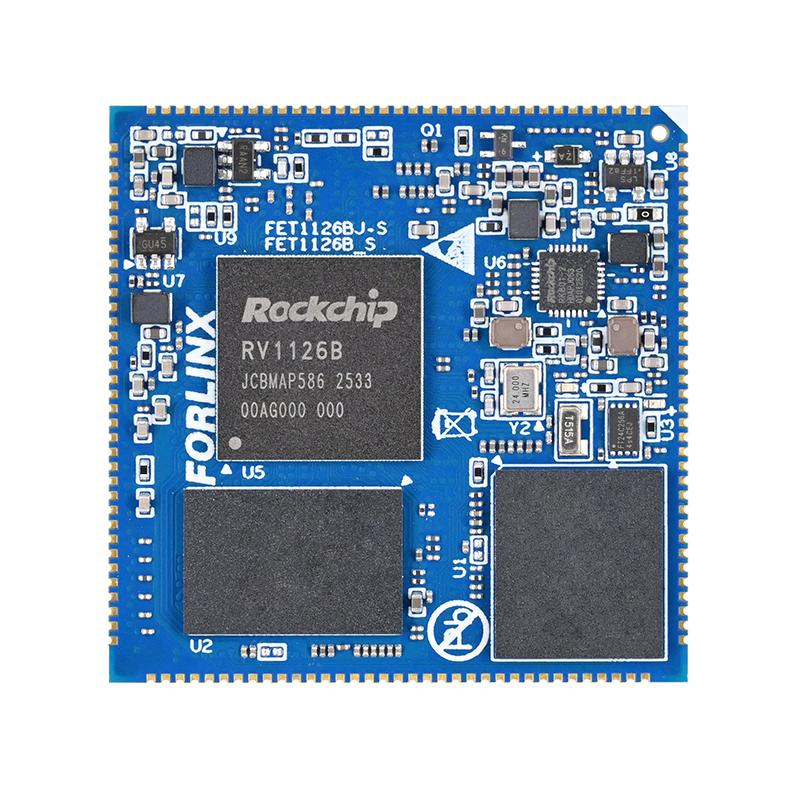
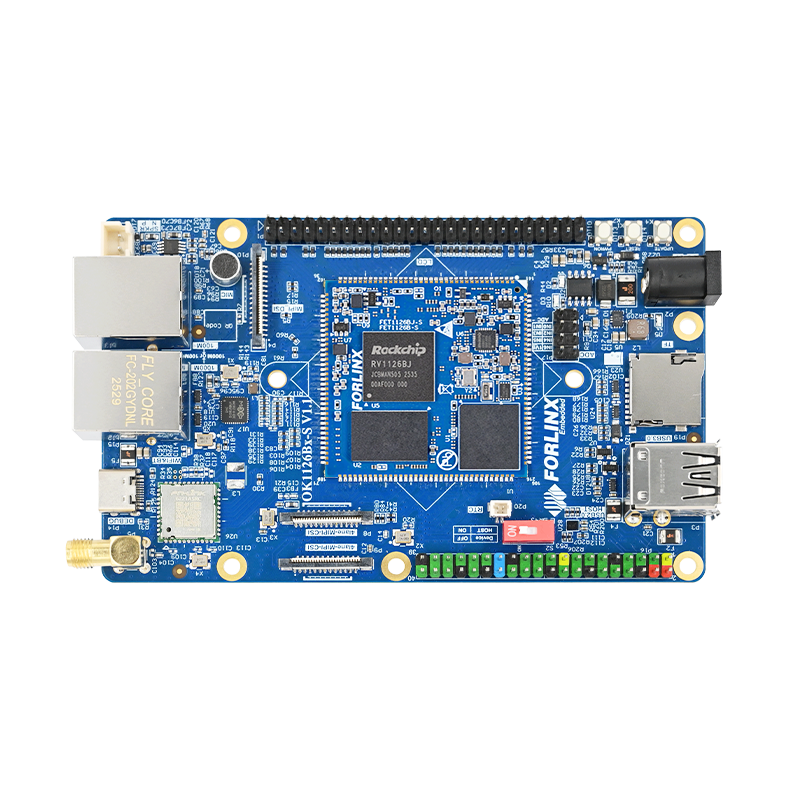
The reference setup uses the Forlinx OK1126B-S development board, Linux 6.1 and the Rockit multimedia framework. A TP2855 video decoder receives the four analogue high-definition (AHD) feeds and passes them to the RV1126B via a single MIPI input.
- The hardware fisheye correction (FEC) block corrects lens distortion in each feed.
- The AVSP hardware block stitches the corrected frames into a single panorama.
- The YOLOv8 model detects people in the stitched image.
The Forlinx solution brief reports 20–30% CPU utilisation for the demonstration. It also lists two cameras for a 180° view and four or five cameras for a 360° view. The setup described here uses four cameras. When evaluating a prototype, measure CPU utilisation at the intended resolution and frame rate with detection enabled.
Camera placement and calibration
Position the cameras so that adjacent fields of view overlap. Intrinsic calibration determines the imaging geometry and lens distortion of each camera. Extrinsic calibration determines the relative position and orientation of the cameras. The video pipeline uses these parameters to correct lens distortion and align the images before stitching. Check the calibration again after replacing or repositioning a camera, lens or mount.
Testing person detection at stitch boundaries
Exposure differences or small alignment errors between adjacent cameras can change how a person appears at a stitch boundary and affect detection. For a fixed equipment enclosure, have a person approach from each monitored direction and walk across every stitch boundary. Include the maximum distance at which detection is required and repeat the test under the lighting conditions expected on site.
Compare the stitched image and detection results with the original camera feeds. Record any missed detections and check whether the operator can follow the person across the panorama.
Deployment considerations
Potential applications include equipment perimeter monitoring, long-range building monitoring, monitoring around power transmission towers, vessel monitoring and surround view for robots.
- Fixed installations. Check for blind spots around the equipment and verify that the mounts hold their alignment.
- Mobile platforms. Evaluate image alignment and person detection under vibration and changing light as part of the trial.
- Networked systems. Measure bandwidth using the streams the deployed system will transmit.
For a prototype review, share your camera specifications, mounting layout, operating conditions and required detection distance with Forlinx. Our engineers can help you evaluate the RV1126B system-on-module and identify the development resources for your setup.
Frequently asked questions
How many cameras does the reference setup use?
It uses four AHD fisheye cameras. A TP2855 video decoder receives all four feeds and connects to a single MIPI input on the RV1126B.
Is person detection applied to each camera feed?
YOLOv8 processes the stitched panorama. Hardware blocks on the RV1126B correct lens distortion and stitch the camera images before inference.
What should I measure on my prototype?
Check coverage and blind spots, measure CPU utilisation at the intended resolution and frame rate, and record missed detections at stitch boundaries and at the maximum required detection distance.