
Forlinx Introduces FET-MX952x-C SoM Based on NXP i.MX 952 with 2 TOPS Edge AI and Industrial-Grade Design
As edge devices take on more AI processing, visual computing, and real-time control tasks, embedded system developers need hardware that can handle these workloads without adding unnecessary complexity to their designs.
Forlinx Embedded introduces the FET-MX952x-C System on Module (SoM), built around NXP's i.MX 952 applications processor. Combining quad-core Arm Cortex-A55 processing, an integrated NXP eIQ Neutron NPU rated at 2 eTOPS, graphics and multimedia acceleration, and industrial connectivity, the module provides a flexible foundation for intelligent embedded systems.
Designed for industrial automation, edge AI, machine vision, embedded displays, and connected IoT devices, the FET-MX952x-C integrates memory, storage, and power management into a module for use with application-specific carrier boards.
1. Heterogeneous Multicore Processing for Intelligent Embedded Systems
At the heart of the FET-MX952x-C is the NXP i.MX 952 processor, featuring three types of Arm processing cores:
- 4 × Arm Cortex-A55 cores running at up to 1.7 GHz for application processing and Linux workloads.
- 1 × Arm Cortex-M7 core running at up to 800 MHz for real-time processing and time-sensitive control.
- 1 × Arm Cortex-M33 core running at up to 333 MHz for low-power and real-time processing, including system management functions.
This heterogeneous architecture allows workloads to be distributed across application and real-time processing domains.
For example, the Cortex-A55 cores can run a Linux-based user interface and network applications while the Cortex-M7 handles time-sensitive control tasks. Use of the Cortex-M33 depends on the system firmware and the software resources available to the application.
This approach is useful in industrial equipment that combines graphical interfaces, network communication, and real-time device control. Actual timing behavior depends on the software architecture, peripheral configuration, and system validation.
The FET-MX952x-C offers 2 GB, 4 GB, or 8 GB LPDDR4X memory configurations with 64 GB eMMC storage, giving developers flexibility when selecting a configuration for their applications.
2. Integrated eIQ Neutron NPU for Edge AI Applications
AI inference is becoming increasingly common in industrial and commercial embedded devices. Applications such as object detection, visual inspection, and equipment monitoring can benefit from processing data locally.
The i.MX 952 processor used on the FET-MX952x-C integrates an NXP eIQ Neutron Neural Processing Unit (NPU), specified at 2 eTOPS for AI acceleration.
The 2 eTOPS figure is an accelerator performance specification, rather than a measurement of application-level inference speed. Actual throughput and latency depend on the model architecture, numerical precision, supported operators, software optimization, and memory bandwidth. Model performance should be evaluated on the target hardware.
The NPU accelerates supported inference operations, allowing the CPU to handle application logic, communication, and other system tasks. Workloads that are not supported by the NPU may require execution on other processing resources.
Potential applications include:
- Industrial inspection: running validated models to identify objects, defects, or abnormal conditions in camera images.
- Smart monitoring: analyzing visual information from connected cameras.
- Robotics: supporting selected visual recognition and perception tasks.
- Edge IoT: performing supported inference tasks on locally acquired data.
By combining application processing, NPU acceleration, and image-processing capabilities in one SoM, the FET-MX952x-C provides a platform for compact edge AI products.
3. Graphics, 4K Video, and Camera Processing
Beyond AI inference, the FET-MX952x-C provides multimedia resources for graphical interfaces, video playback, and camera-based applications.
Graphics and display
The module incorporates the processor's Arm Mali-G310 GPU, with support for OpenGL ES 3.2, Vulkan 1.2, and OpenCL 3.0.
The processor also provides dedicated 2D graphics resources for operations such as scaling, rotation, blending, and display composition. Availability of graphics APIs and acceleration features depends on the supplied drivers and software stack.
MIPI DSI and LVDS display interfaces support applications such as industrial HMI panels, control terminals, and embedded visualization systems.
Display capabilities include:
- A four-lane MIPI DSI interface.
- LVDS output supporting resolutions up to 1920 × 1080 at 60 Hz.
- Two independent display output streams, subject to display configuration and software support.
These resources enable systems to present operating information, visual alerts, camera previews, and interactive interfaces.
Video and camera processing
The processor's video processing unit (VPU) supports hardware decoding of H.264 and H.265 video at up to 4K at 60 fps, and hardware encoding of H.264 video at up to 4K at 30 fps. These are maximum capabilities; supported codec profiles, simultaneous workloads, and achieved performance depend on the software configuration.
Camera acquisition and image processing use separate hardware resources. The integrated Image Signal Processor (ISP) processes supported camera sensor data, while MIPI CSI-2 connectivity supports one four-lane connection or two two-lane connections.
The ISP handles camera image processing; the VPU handles video compression and decompression. Camera compatibility and the available processing pipeline depend on sensor drivers, ISP configuration, and BSP support.
Typical use cases include machine vision, industrial video monitoring, smart displays, and visual sensing equipment.
4. Industrial Connectivity and Flexible Hardware Integration
Embedded system designers need communication interfaces, expansion options, and a practical path to hardware integration alongside processing performance.
The FET-MX952x-C exposes processor interface resources through its board-to-board connectors for use on a custom carrier board.
Key interface resources include:
| Interface | FET-MX952x-C Interface Resources |
|---|---|
| Ethernet | Up to 2 × Gigabit Ethernet interfaces with TSN support; an additional SGMII interface is listed by Forlinx and is multiplexed with PCIe. |
| CAN FD | Up to 3 interfaces. |
| PCIe | 1 × PCIe Gen 3 x1 interface; multiplexed with the additional SGMII interface. |
| USB | 2 × USB 2.0 controllers with host or device support. |
| UART | Up to 8 interfaces. |
| SPI | Up to 8 interfaces. |
| I²C | Up to 7 interfaces exposed by the module. |
| MIPI CSI-2 | One four-lane connection or two two-lane connections. |
| MIPI DSI | 1 × four-lane display interface. |
| LVDS | Two four-lane links or one eight-lane configuration; up to 1080p at 60 Hz. |
| ADC | 1 × 12-bit ADC with up to 8 input channels and a sampling rate of up to 1 MS/s. |
| SD / SDIO | SD 3.0 and SDIO 3.0 support. |
Interface counts describe maximum available resources rather than a guarantee that all interfaces can operate simultaneously. Pin multiplexing, carrier board routing, and software support determine the usable combination.
TSN-capable Ethernet interfaces provide a foundation for time-aware industrial networking. End-to-end timing behavior also depends on the network infrastructure, synchronization, and software configuration.
CAN FD provides communication resources for industrial controllers and distributed devices. Carrier boards must include the appropriate physical-layer circuitry and protection for the intended application.
The module uses four 80-pin board-to-board connectors with a 0.5 mm pitch and 2.0 mm mating height. Developers can design application-specific carrier boards while retaining the processor, memory, storage, and power-management circuitry on the SoM.
5. Industrial-Grade Design and Hardware Security
Reliability is a major consideration for embedded systems deployed in factories and other demanding environments.
Forlinx specifies an industrial operating temperature range of -40°C to +85°C for the FET-MX952x-C. The thermal design must keep the module and its components within their operating limits under the intended workload.
The module uses a 12 V DC input. Carrier board power design and cooling should follow the module's hardware documentation.
Forlinx reports environmental, stability, and aging testing for the module. Product-level reliability also depends on the carrier board, enclosure, cooling, and deployment conditions.
The i.MX 952 integrates an EdgeLock Secure Enclave, providing hardware-backed resources for secure boot, cryptographic operations, and other security functions. Enabling these protections requires appropriate provisioning and software integration.
NXP positions the i.MX 952 processor family to support functional safety development targeting ISO 26262 ASIL B and IEC 61508 SIL 2 requirements.
These processor-level capabilities can support system development, but they do not establish functional safety certification or automotive qualification of the Forlinx module or a finished product. Compliance depends on the selected components, system architecture, development process, and validation.
6. Linux Support and Development Board Resources
Developers also need a software environment and accessible hardware for evaluation, debugging, and application development.
Forlinx lists Linux kernel 6.18 support for the FET-MX952x-C. Available drivers, middleware, and example applications should be checked against the supplied BSP release.
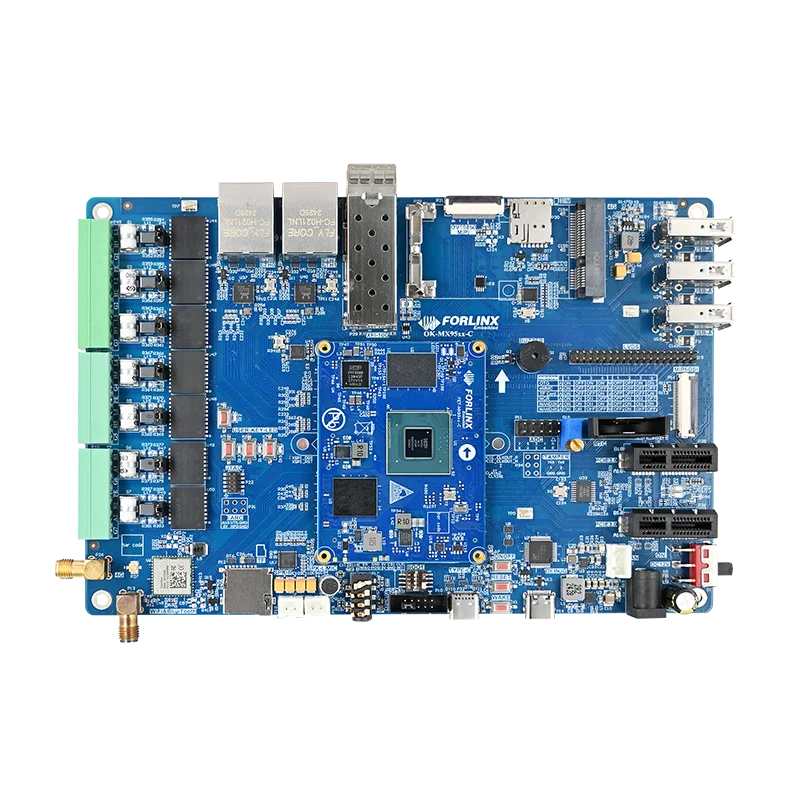
The matching OK-MX952x-C development board combines the SoM with a carrier board that exposes commonly used peripherals.
The development board includes:
- Two 10/100/1000 Mbps Ethernet ports with RJ45 connectors.
- MIPI DSI and LVDS display interfaces.
- A MIPI CSI camera connector, with OV13850 camera support listed by Forlinx.
- Onboard 2.4 GHz / 5 GHz dual-band Wi-Fi and Bluetooth 5.0.
- Three CAN FD interfaces and two RS485 interfaces.
- A PCIe Gen 3 x1 expansion slot.
- A Mini PCIe connector for a compatible 4G LTE module, with EC20 compatibility listed by Forlinx.
- Three USB 2.0 host ports expanded through a hub, plus a separate USB 2.0 Type-C OTG interface.
- A dedicated USB Type-C debug connector providing USB-to-UART access for the Cortex-A55, Cortex-M33, and Cortex-M7 domains.
The Type-C debug connector provides serial-console access and is separate from the USB OTG connector. Forlinx lists a JTAG interface for core debugging.
Firmware flashing is supported through a microSD card or USB OTG using the appropriate carrier board connections and boot configuration.
Engineers can use the OK-MX952x-C to evaluate peripherals, test application software, and assess their system architecture before developing a custom carrier board.
This SoM-and-carrier-board approach reduces the amount of core hardware that needs to be designed during initial evaluation and provides a path toward application-specific integration.
7. Target Applications
The FET-MX952x-C combines heterogeneous processing, AI acceleration, multimedia resources, and industrial connectivity for a range of embedded applications.
Industrial HMI and Automation
Industrial equipment often requires graphical interfaces, communication with field devices, and time-sensitive control.
The Cortex-A55 application cores, Cortex-M7 real-time core, graphics resources, and industrial communication interfaces provide a foundation for control panels, machine interfaces, and automation devices.
Machine Vision and Smart Inspection
The integrated ISP, MIPI CSI-2 connectivity, and eIQ Neutron NPU make the module a candidate for compact vision systems that process data locally.
Developers can combine image acquisition, supported AI inference workloads, and equipment communication within one embedded platform. Detection accuracy and processing speed must be validated with the intended cameras, models, and operating conditions.
Embedded Displays and Transportation Interfaces
Hardware-accelerated graphics, video processing, MIPI DSI, LVDS, and CAN FD provide resources for dashboards, operator terminals, and related visualization systems.
For automotive or safety-related deployments, developers must assess component qualification and system-level requirements for the intended use.
Industrial IoT Gateways
Ethernet, CAN FD, serial communication, and Linux support provide a foundation for gateways that connect industrial devices, collect field data, and perform local processing.
Intelligent Edge Devices
For products requiring a combination of AI inference, connectivity, display functions, and real-time processing, the FET-MX952x-C offers a reusable computing platform across application-specific carrier board designs.
From Evaluation to Product Integration
With the FET-MX952x-C System on Module, Forlinx Embedded brings the NXP i.MX 952 processor into a platform for embedded product development.
Quad-core Cortex-A55 processing, an integrated eIQ Neutron NPU specified at 2 eTOPS, industrial interfaces, and Linux support provide resources for edge computing applications.
Pairing the module with the OK-MX952x-C development board allows developers to evaluate system functions and measure application performance before committing to a custom carrier board design.
For teams developing industrial AI devices, smart displays, machine vision equipment, or connected control systems, the FET-MX952x-C provides an integrated starting point for evaluation and product development.
Explore the FET-MX952x-C System on Module or contact Forlinx Embedded for hardware specifications, development resources, and project evaluation support.