
RK3572 SoM CAN/CAN-FD Benchmark: Zero Frame Loss Under 96% Bus Load
In industrial control and smart IoT devices, the real-time performance, stability, and anti-interference capability of bus communication directly determine the overall reliability of the equipment. Especially in complex working conditions characterized by high loads and strong electromagnetic interference, the performance of the CAN/CAN-FD bus is a core hardware benchmark for embedded master control chips.
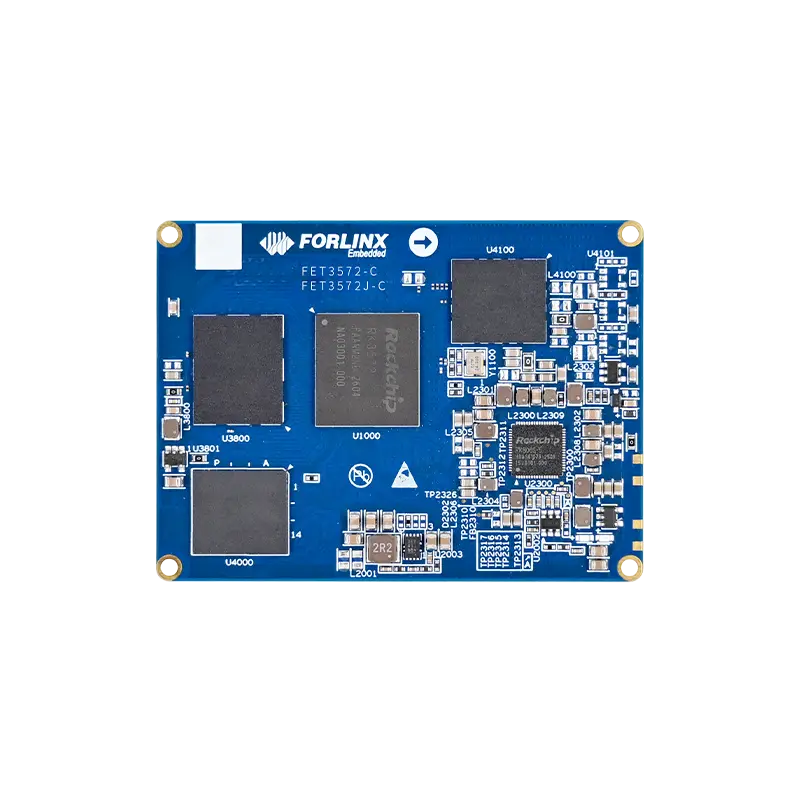
As Rockchip latest mid-range processor, the RK3572 integrates 4 x native CAN-FD controllers, featuring high real-time performance, high reliability, and multi-channel concurrent communication capabilities. Today, through a full suite of standardized, practical tests, this analysis comprehensively validates the real-world performance of the RK3572 CAN-FD bus.
Multi-Dimensional Validation of Native CAN/CAN-FD
The RK3572 processor is built on an advanced 8nm process and features an 8-core architecture (2×A73 + 6×A53). It is specifically designed for industrial control equipment, Industrial IoT (IIoT), and edge AI computing scenarios. Given the core requirement for stable communication in its application scenarios, the RK3572 has been specially reinforced in its communication configuration. The chip natively integrates four independent CAN-FD interfaces, supporting both CAN 2.0 and CAN-FD dual modes, making it suitable for diverse scenarios ranging from low-speed sensor data acquisition to high-speed, large-volume data transmission.
This test completes a full-scenario performance validation from core dimensions such as load throughput, real-time performance, and multi-channel concurrency.
Standardized Test Environment Ensures Credible and Authentic Data
To replicate real-world operating conditions, this test establishes a closed-loop bus test environment. The entire process is conducted without parameter optimization or special adaptations, presenting the chip’s native performance.
Test Equipment Information
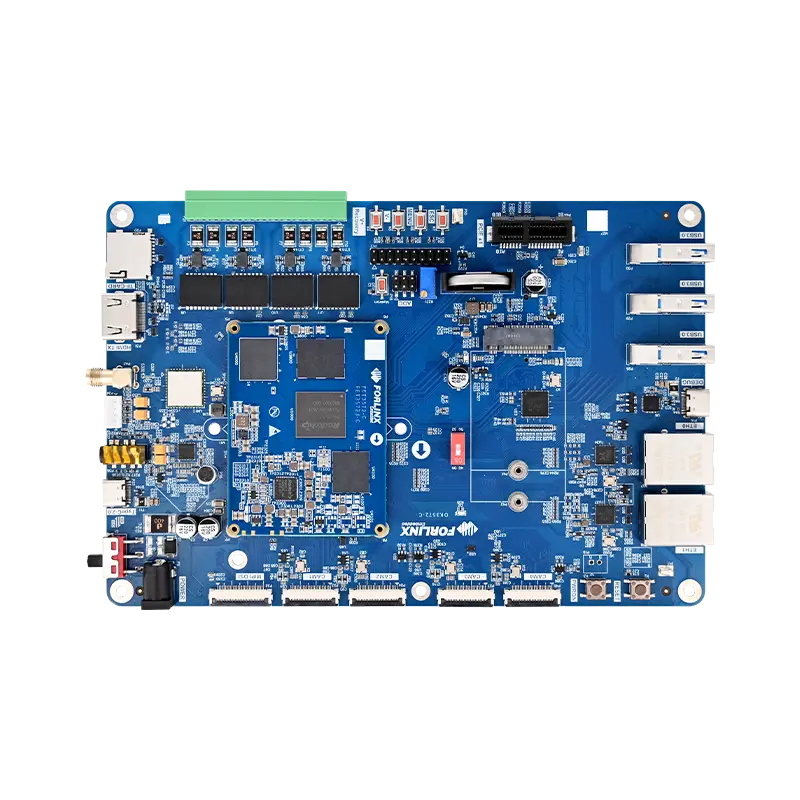
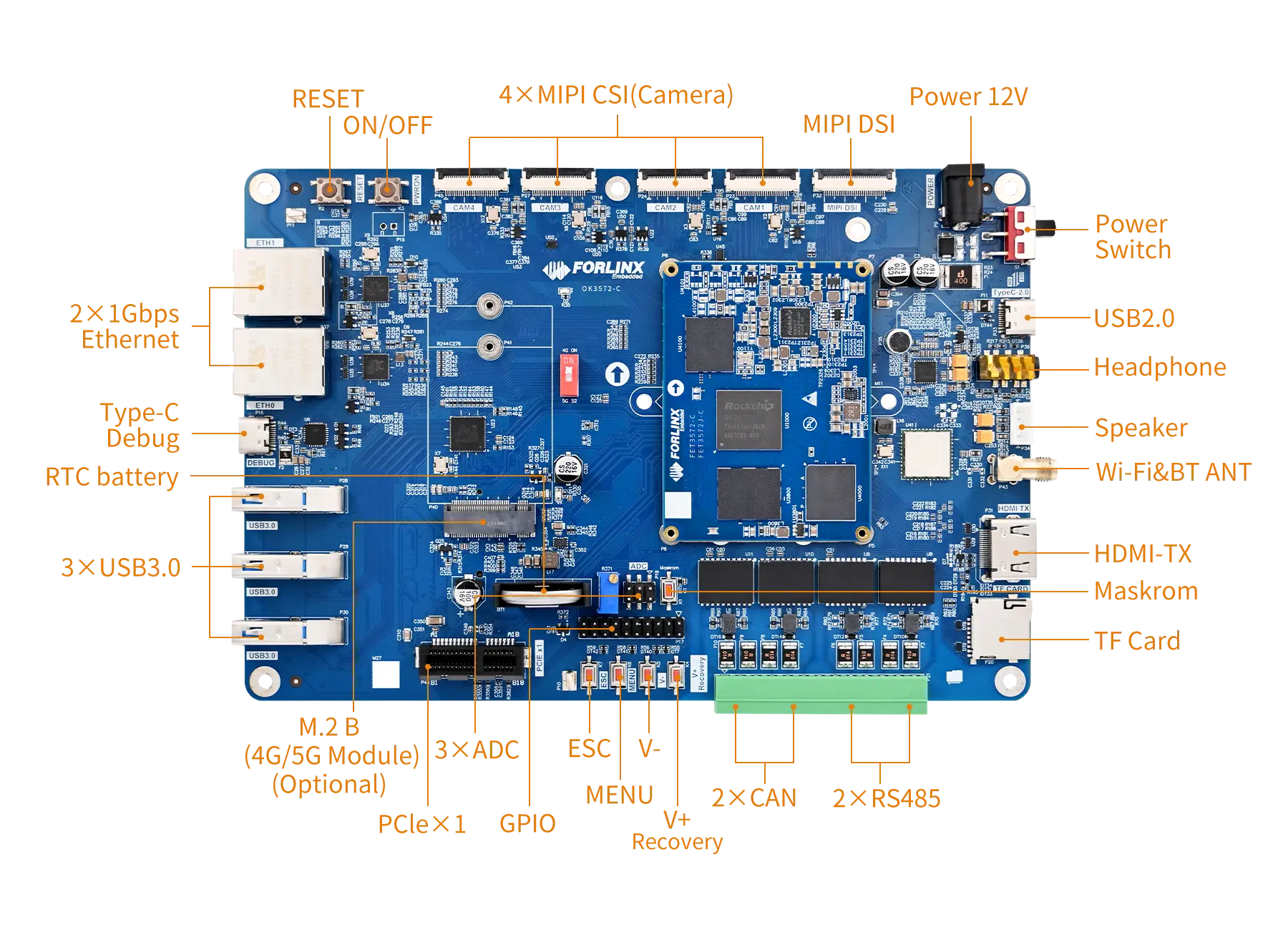
| Platform | Kernel Version | Hardware Version: OK3572-C V1.0 (Carrier board) + FET3572-C (SoM) | CAN-FD Support: Yes | Number |
| RK3572 | 6.12.58 | OK3572-C V1.0+FET3572-C | √ | 2 |
CAN Performance Test
First, a series of tests were conducted on the CAN interfaces, covering six key operating conditions: single-channel independent receiving, multi-channel independent receiving, single-channel independent transmission, multi-channel independent transmission, single-channel bidirectional transceiving, and multi-channel bidirectional transceiving. The corresponding test data is as follows:
| Number | Test Parameter | Parameter | Capability | Remarks | Summary | ||
| Number | Baud Rate | Frame type | |||||
| 1 | Single channel receive only | 1 | 1M | Extended ID Frame | Frames per Second: 6814 | Bus Occupancy: 88% | Pass |
| 2 | Multi-channel receive only | 2 | 1M | Extended ID Frame | Frames per Second: 6808 | Bus Occupancy: 88% | Pass |
| 3 | Single channel receives only | 1 | 1M | Extended ID Frame | Frames per Second: 6824 | Bus Occupancy: 88% | Pass |
| 4 | Multi-channel send only | 2 | 1M | Extended ID Frame | Frames per Second: 6860 | Bus Occupancy: 89% | Pass |
| 5 | Send and receive simultaneously | 1 | 1M | Extended ID Frame | Frames per Second: 7679 | Bus Occupancy: 92% | Pass |
| 6 | Send and receive simultaneously | 2 | 1M | Extended ID Frame | Frames per Second: 7684 | Bus Occupancy: 92% | Pass |
Test Conclusions:
Receiving capability is normal: Under bus conditions close to full load, no frame loss occurs during single-channel or dual-channel simultaneous receiving;
Simultaneous sending and receiving: For both single-channel and dual-channel setups at a 1:1 ratio, bus utilization can reach around 90% without any frame loss or issues such as insufficient transmit buffer space;
CAN-FD Performance Test
Next, the CAN-FD interface will be tested, following the same categories as described above. The specific test data is as follows:
| Number | Test Parameter | Parameter | Capability | Remarks | Summary | ||
| Number | Baud Rate | Frame type | |||||
| 1 | Single channel receive only | 1 | Arbitration rate: 1 Mbps | Extended ID Frame | Frames per Second: 4994 | Bus Occupancy: 89% | Pass |
| Data rate: 4M | |||||||
| 2 | Multi-channel receive only | 2 | Arbitration rate: 1 Mbps | Extended ID Frame | Frames per Second: 4985 | Bus Occupancy: 88% | Pass |
| Data rate: 4M | |||||||
| 3 | Single channel receives only | 1 | Arbitration rate: 1 Mbps | Extended ID Frame | Frames per Second: 5004 | Bus Occupancy: 89% | Pass |
| Data rate: 4M | |||||||
| 4 | Multi-channel send only | 2 | Arbitration rate: 1 Mbps | Extended ID Frame | Frames per Second: 5028 | Bus Occupancy: 89% | Pass |
| Data rate: 4M | |||||||
| 5 | Send and receive simultaneously | 1 | Arbitration rate: 1 Mbps | Extended ID Frame | Frames per Second: 5474 | Bus Occupancy: 96% | Pass |
| Data rate: 4M | |||||||
| 6 | Send and receive simultaneously | 2 | Arbitration rate: 1 Mbps | Extended ID Frame | Frames per Second: 5488 | Bus Occupancy: 96% | Pass |
| Data rate: 4M | |||||||
Test Conclusions:
Receiving capability is normal: Under bus conditions close to full load, no frame loss occurs during single-channel or dual-channel simultaneous receiving;
Single-channel or dual-channel, 1:1 simultaneous sending and receiving, with a maximum bus utilisation of 96 per cent; no frame loss and no issues such as lack of transmission space;
3. Application Scenarios
Leveraging excellent CAN-FD bus performance, Forlinx Embedded FET3572-C SoM is widely adaptable to various high-reliability, high-real-time scenarios:
Industrial Field: PLC industrial control terminals, motion controllers, industrial gateways, industrial robots;
Power & New Energy: Power monitoring terminals, photovoltaic/wind power monitoring, energy storage management devices;
AIoT Edge Computing: Edge data gateways, multi-node bus monitoring terminals.
Intelligent Measurement & Control Equipment: Precision motion control, equipment status monitoring, industrial data acquisition terminals;
Medical Intelligent Terminals: Medical monitoring, intelligent medical measurement and control devices.
To meet the growing demands of industrial intelligence and IoT device innovation, the Forlinx Embedded FET3572-C System-on-Module (SoM) delivers a high-performance, cost-optimized core solution for next-generation terminal devices.
Ready to accelerate your next-generation industrial design?
Forlinx Embedded FET3572-C SoM ensures outstanding CAN-FD stability and computational efficiency, powering your edge devices with robust and reliable performance. Samples are now officially available for pre-order.