


OK3568-C Single Board Computer Based on Rockchip RK3568 Processor
OK3568-C single board computer(SBC)/development board is populated with SoM FET3568-C on carrier board through four ultra-thin connectors. The carrier board ensures the SoM source is fully available to achieve users' fast evaluation purpose. Besides, the board is designed with ESC solution which simplifies design reference to help users to shorten your product time-to-market.
OK3568-C SBC
Advanced and Robust
FET3568-C SoM is equipped with quad-core 64-bit Cortex-A55 processor with built in NPU based on advanced 22nm process technology,
running at up to 2.0GHz, and plenty of high-speed peripheral interfaces are available.
High-performance NPU for Lightweight AI
Neural network acceleration engine with processing performance up to 1 TOPS. Supports RKNN-Toolkit.
In addition, with its strong compatibility, network models based on a series of frameworks such as TensorFlow/MXNet/PyTorch/Caffe can be easily converted.
Multiple Display Interfaces: Realize Three-Screen Heterogeneous Display
HDMI2.0, eDP, LVDS, RGB Parallel and MIPI-DSI are all well supported, besides, it supports three displays simultaneously output up to 4K,
which is preferable and applicable for PDA, cash register, multi-screen advertising machine, karaoke machine, electronic bus stop board, self-service machine, etc.
Powerful Video Codec Performance
Support 4K resolution H.264/H.265/VP9 and other formats high-definition hard decoding,
and can support multiple video sources decoding simultaneously, support HDR10 with excellent color and dynamic range performance;
FET3568-C SoM supports H.264 and H.265 format hardware encoding at 1080p60fps, and supports dynamic code rate, frame rate, and resolution adjustment.
Rich High-Speed Interfaces: Expand Functionality and Connect More Efficiently
Equipped with 3 PCIe, 4 separate USB, 3 SATA controllers, and 2 builtin GMAC can support RGMII/ SGMII/ QSGMII(2MAC) to expand dual Gigabit Ethernet ports.
Industrial Applicable EMC Protection
OK3568-C carrier board is designed with EMC protection solution, which is applicable for industrial related scenes.
CAN and Ethernet are designed with EFT3, ESD3 and Surge3; HDMI and USB are designed with ESD3.
User-friendly Designing
Multiple pins are multiplexed on OK3568-C carrier board, user friendly and easy to go.
Diverse Networking Connectivity
Dual native Gigabit Ethernet, dual-band WiFi and 4G/ 5G modem slot are all available on OK3568-C carrier board for networking requirement.
Rockchip RK3568 SoM / SBC Video
Forlinx RK3568 SoM & Single Board Computer
▊ Hardware Features
|
FET3568-C SoM Basic Parameters |
|||
|---|---|---|---|
|
CPU |
Rockchip RK3568 Quad-core Cortex-A55 @ 2.0 GHz |
||
|
GPU |
• ARM Mali-G52-2EE |
||
|
NPU |
1 TOPS performance; supports INT8, INT16, FP16, and BFP16 mixed operations |
||
|
VPU |
Decoding: |
Encoding: |
|
|
RAM |
1 GB / 2 GB / 4 GB / 8 GB DDR4 (Standard: 2 GB) |
ROM |
8 GB / 16 GB / 32 GB eMMC |
|
OS |
Linux 4.19 / 5.10 + Qt 5.12, Debian 11, Android 11, Forlinx Desktop 22.04 |
Input Voltage |
DC 5 V |
|
Package |
Board-to-board connector (4 x 80-pin, 0.5 mm pitch) |
||
|
Working Temp. Range |
0 °C to 70 °C / -40 °C to 85 °C |
Dimensions |
45 mm x 70 mm |
|
FET3568-C SoM Software Support |
||||
|---|---|---|---|---|
|
Operating Systems |
Linux 5.10.160 + Qt 5.15.8, Android 11, Forlinx Desktop 20.04 (Ubuntu 20.04 based), Debian 11, AMP (based on Linux 4.19.232 + Qt 5.15.8), OpenHarmony 4.1 (based on Linux 5.10.184) |
|||
|
OS Adaptation Details |
Product |
RAM |
ROM |
Supported OS |
|
FET3568-C |
1 GB |
8 GB |
Linux 5.10.160, AMP, OpenHarmony 4.1* |
|
|
2 GB |
16 GB |
Linux 5.10.160, Android 11, Forlinx Desktop 20.04, Debian 11, AMP, OpenHarmony 4.1 |
||
|
2 GB |
32 GB |
Linux 5.10.160, Android 11, Forlinx Desktop 20.04, Debian 11, AMP, OpenHarmony 4.1* |
||
|
4 GB |
32 GB |
|||
|
FET3568J-C |
1 GB |
8 GB |
Linux 5.10.160, AMP, OpenHarmony 4.1* |
|
|
2 GB |
16 GB |
Linux 5.10.160, Android 11, Forlinx Desktop 20.04, Debian 11, AMP, OpenHarmony 4.1 |
||
|
4 GB |
32 GB |
Linux 5.10.160, Android 11, Forlinx Desktop 20.04, Debian 11, AMP, OpenHarmony 4.1* |
||
|
FET3568J-C2 |
4 GB |
32 GB |
Linux 5.10.160, Linux 6.1.x (AMP Architecture), Android 11, Forlinx Desktop 20.04*, Debian 11*, AMP*, OpenHarmony 4.1* |
|
|
8 GB |
64 GB |
|||
|
|
Note: Systems marked with "*" are currently under adaptation. | |||
|
Flashing Methods |
• TF card (SD card) • USB OTG (Rockchip Tool) |
|||
|
FET3568-C SoM Functional Interface Parameters |
|||
|---|---|---|---|
|
Interface |
QTY |
Description / Specifications |
|
|
Display |
3 |
Equipped with 3 independent display controllers; supports 3 simultaneous outputs via RGB, LVDS, MIPI DSI, HDMI, or eDP interface. |
|
|
Camera |
2 |
1 x 8-bit DVP, 1 x 4-lane MIPI CSI |
|
|
Audio |
4 |
1 x 8-ch I2S/TDM, 2 x 2-ch I2S, 1 x 8-ch PDM |
|
|
SDIO |
3 |
SDIO 3.0, data throughput up to 104 MB/s |
|
|
Ethernet |
2 |
2 x GMAC (Gigabit Ethernet MAC), via RGMII / RMII |
|
|
USB 2.0 |
2 |
2 x USB 2.0 Host (dedicated, not multiplexed with USB 3.0) |
|
|
USB 2.0 (Extra) |
2 |
1 x USB 2.0 Host and 1 x USB 2.0 OTG (multiplexed with USB 3.0); can be used as 2 independent USB 2.0 if USB 3.0 is not utilized |
|
|
USB 3.0 |
2 |
1 x USB 3.0 Host, 1 x USB 3.0 OTG |
SerDes Multiplexing: |
|
SATA |
3 |
SATA 3.0, Up to 6.0 Gbps, supports eSATA |
|
|
PCIe 2.1 |
1 |
PCIe 2.1 x1, Up to 5.0 Gbps, RC (Root Complex) mode |
|
|
PCIe 3.0 |
2 |
PCIe 3.0, configurable as 1 x 2-lane or 2 x 1-lane, Up to 8.0 Gbps per lane. |
|
|
UART |
10 |
Baud rate Up to 4 Mbps |
|
|
CAN |
3 |
Supports CAN 2.0B protocol |
|
|
SPI |
4 |
Master and Slave modes are configurable |
|
|
I2C |
5 |
Supports 7-bit and 10-bit addressing, Up to 1 Mbps |
|
|
PWM |
16 |
32-bit timer/counter |
|
▊ Carrier Board

|
|
| OK3568-C Single Board Computer (SBC) Features | ||
|---|---|---|
| Function | QTY | Description / Parameters |
| HDMI 2.0 | 1 | Resolutions Up to 1080p @ 120 Hz or 4096 x 2304 @ 60 Hz |
| eDP | 1 | Supports eDP 1.3 with resolutions Up to 2560 x 1600 @ 60 Hz |
| LVDS | 1 | Single-channel output, resolution Up to 1280 x 800; natively adapted for Forlinx 10.1-inch LVDS screens |
| LCD (RGB) | 1 | Supports RGB888 with resolution Up to 1280 x 800; multiplexed with SPI0, SPI2, UART3, UART4, UART5, and UART7 |
| The SBC defaults to the above functions; RGB functionality can be enabled via software configuration | ||
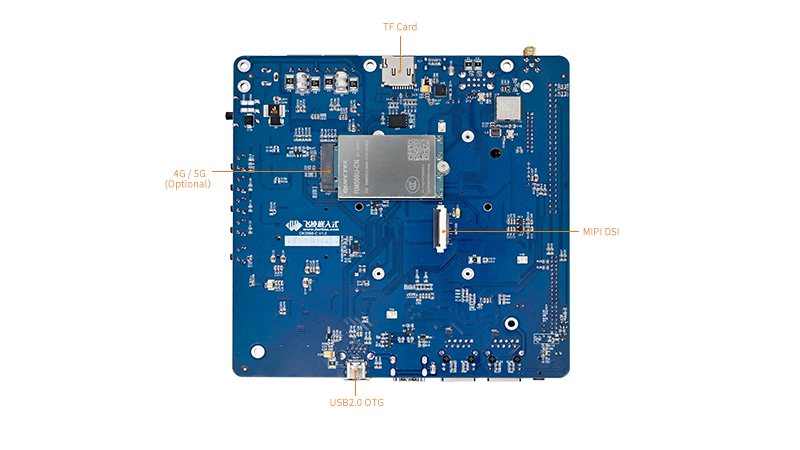
| MIPI DSI | 1 | Single-channel output, resolution Up to 1920 x 1080 @ 60 Hz; natively adapted for Forlinx 7-inch MIPI screens (1024 x 600) |
| Camera | 1 | 1 x 4-lane MIPI CSI interface, adapted for OV13850 camera module |
| Audio | 1 | 1 x Stereo headphone jack (3.5 mm), 1 x 1.3 W Class-D amplifier output, and 1 x MIC input |
| TF Card | 1 | Supports storage expansion and system firmware flashing |
| Ethernet | 2 | 2 x 10/100/1000 Mbps auto-negotiation Ethernet ports (RJ45) |
| 4G / 5G | 1 | M.2 Key-B slot (USB 3.0 / 2.0 signals) for 4G/5G module expansion |
| Verified modules: Quectel EM05-CE (4G, EC20 compatible), RM500U-CN (5G) | ||
| Wi-Fi / BT | 1 |
On-board AW-CM358SM module; supports 2.4 GHz / 5 GHz dual-band Wi-Fi and Bluetooth 5.0. Note: Wi-Fi utilizes 1 x SDIO; Bluetooth occupies 1 x UART (Bluetooth audio/HFP not supported). |
| Bluetooth | 1 | |
| USB 2.0 | 2 | 2 x USB 2.0 Host (Type-A) |
| USB 3.0 | 1 | 1 x USB 3.0 Host (Type-A); USB 2.0 signal is multiplexed with download pins, switchable via S2 DIP switch |
| USB 2.0 OTG | 1 | Type-C interface (shares USB 2.0 signals with USB 3.0 Host); supports Device mode for flashing and ADB debugging |
| PCIe 2.1 | 1 | Standard PCIe x1 slot; pins can be multiplexed for SATA functionality via software modification |
| PCIe 3.0 | 1 | Standard PCIe x4 slot; supports software configuration as 2 x PCIe x1 |
| UART | 3 | 3.3 V TTL level; routed to 2.54 mm pitch pin headers |
| CAN | 2 | Supports CAN 2.0B, Up to 1 Mbps; with galvanic isolation and ESD protection |
| SPI | 2 | 3.3 V TTL level; routed to 2.54 mm pitch pin headers |
| I2C | 1 | 3.3 V TTL level; routed to 2.54 mm pitch pin headers |
| RTC | 1 | On-board CR2032 battery backup for persistent timekeeping during power-off |
| Keys | 8 | Includes: Reset, Power, OTG, Maskrom, VOL+, VOL-, HOME, and ESC |
| Debug | 1 | On-board USB-to-UART bridge, routed via Type-C interface; default baud rate: 115,200 bps |
| Power | 1 | 12 V DC input |
| LED | 2 | User-programmable status LEDs |
| FSPI | 1 | Unpopulated (NC) by default; function not supported in current revision |
Note: The parameters in the table are hardware design specifications or CPU theoretical values.
▊ Accessories
Please click here to get more information about the supported modules and accessories.
▊ Documentation
Reference Manuals
Hardware Related
Product Datasheet
User Guide
Carrier Board Schematic
Carrier Board PCB
SoM Pinmux
Software & BSP
OS Image
Testing Demo
Source Code
Manual
Request a Quote
Fill out the form below for volume pricing or technical specifications. We'll get back to you within 24 hours.
▊ How To Buy & Shipment
1. Order Online: We have an online store on Alibaba. Please contact us for details.
2. Order Offline: Send your inquiry to [email protected].
3. Payment Terms: 100% T/T in advance.
1. Delivery: Goods shipped by express upon receipt of payment.
2. Lead Time: Sample orders within 5 working days; bulk orders 6 weeks.
3. Shipping Charge: Buyers bear the shipping cost.
▊ Standard Packing List
▊ Forlinx Recommended Products
Architecture: 4x [email protected]
Frequency: 1.3GHz,1.6GHZ
RAM: 1GB/2GB/4GB LPDDR4
ROM: 8/16/32/64GB eMMC
Architecture: 4x Cortex-A76+4x Cortex-A55
Frequency: [email protected]/1.6GHz, [email protected]/1.3GHz
RAM: 4GB/8GB/16GB LPDDR4x
ROM: 32GB/64GB/128GB eMMC
Architecture: 4x Cortex-A72+4x Cortex-A53
Frequency: [email protected][email protected]
RAM: 2GB/4GB LPDDR4
ROM: 32GB eMMC
Architecture: Cortex-A55
Frequency: 1.8GHz,2.0GHz
RAM: 1GB/2GB/4GB/8GB DDR4
ROM: 8/16/32/64GB eMMC