


OK3588J-UP5 Single Board Computer
CPU: Rockchip RK3588/RK3588J
Architecture: 4x Cortex-A76+4x Cortex-A55
Frequency: [email protected]/1.6GHz, [email protected]/1.3GHz
RAM: 4GB/8GB/16GB/32GB LPDDR4
ROM: 32GB/64GB/128GB eMMC
System: Android14,ForlinxDesktop 24.04,Linux 6.1
OK3588J-UP5 Development Board | Rockchip RK3588 Industrial Evaluation Kit
The OK3588J-UP5 Development Board/Single Board Computer combines the industrial-grade FET3588J-UP5 SoM with an expansion carrier board to deliver a production-ready evaluation platform. Engineered with rich high-speed interfaces—including 8K HDMI output, quad-channel MIPI CSI, PCIe 3.0, and 5G/Wi-Fi 6 expansion—it eliminates baseboard design complexities and accelerates proof-of-concept transitions into mass deployment across edge AI, smart vision, and industrial computing applications.
FET3588-UP5 / FET3588J-UP5 SoM
Equipped with the Rockchip RK3588J industrial-grade processor,
Forlinx Embedded UP5 series SoM features an LCC+LGA package that exposes all CPU functional pins within a compact 50×50mm footprint,
significantly empowering device miniaturization.
Industrial-Grade Flagship Computing Power, The Safe Choice
What is UP5 Packaging?
UP5 is a System on Module (SoM) packaging standard defined by Forlinx Embedded. "UP" stands for "Universal Package," while "5" indicates the ultra-compact board size of 50mm × 50mm.
This series employs a Land Grid Array (LGA) interface with a total of 624 pins. The LGA solder ball pitch measures 1.25mm, and each solder ball diameter is 0.8mm.
SoM UP5 Advantages
The UP5 series establishes an open standard for SoM hardware compatibility and interchangeability. By defining unified physical dimensions, soldering packages, and pin layouts, it minimizes R&D difficulty and risk.
Hardware Design Reusability: A single carrier board design can adapt to multiple SoM platforms across various performance tiers.
Supply Chain Flexibility: SoMs can utilize chips from multiple silicon vendors, effectively mitigating component supply risks.
Compact Size: The UP5 series balances size, thermal performance, and cost while maintaining pin standardization.
Wide Range of UP5 SoM Options
Forlinx Embedded currently offers UP5 products based on Rockchip RK3588 and RK3576 processors,
with additional UP5 family products continuously launching to support multi-tier platform scaling.
Rich CPU Interface Resources
Meeting Computing, Connectivity & Storage Requirements
Supports multi-channel display output up to 8K@60Hz and multi-camera video input.
Equipped with 2-way Gigabit Ethernet and 3x SATA interfaces (with eSATA support) to facilitate high-speed data transmission between high-capacity storage drives and edge nodes.
Multiple Operating Systems Support
Forlinx Embedded customizes Android, Linux, and Forlinx Desktop operating systems for RK3588 development platforms.
Comprehensive multi-layer industrial testing guarantees 24/7 stable operation, accommodating diverse application workflows.
Wide Range of Application Scenarios
With flagship computing capability and comprehensive industrial interfaces, the FET3588-UP5 empowers applications across edge computing,
smart commercial displays, high-end rugged tablets, intelligent NVR systems, and visual IoT gateways.
Mechanical Dimensions
Equipped with the Rockchip RK3588/RK3588J industrial processor, the module adopts an LCC+LGA package (624 pins) that routes out all functional signals within a compact 50mm × 50mm size.
It enables flexible heat dissipation design and reduces structural enclosure volume for space-constrained installations.
Forlinx UP5 Standard
What is UP5? A Compatible and Compact Package
▊ Hardware Features
| Hardware Parameters of FET3588J-UP5 | ||
|---|---|---|
| Processor | Rockchip RK3588/RK3588J | |
| RK3588 CPU:4×[email protected] + 4×[email protected] | ||
| RK3588J CPU:4×[email protected] + 4×[email protected] | ||
| NPU | 6 TOPS, supporting INT4/INT8/INT16/FP16 combined operations | |
| GPU | Mali-G610 MP4, OpenGLES 1.1, 2.0, 3.2, OpenCL 2.2, Vulkan1.2 | |
| VPU |
Hardware Decoding: • H.265, VP9: up to 8K@60fps • H.264: up to 8K@30fps • AV1: up to 4K@60fps |
|
|
Hardware Encoding: • H.265/HEVC, H.264/AVC: up to 8K@30fps |
||
| RAM | 4GB/8GB/16GB/32GB LPDDR4 | |
| ROM | 32GB/64GB/128GB eMMC | |
| Operating Voltage | DC 5V-13V | |
| Operating Temperature | 0℃ ~ +70℃ / -40℃ ~ +85℃ | |
| Net Weight | 15.9g | |
| Connection | LGA (624 pins; the ball pitch of the LGA is 1.25 mm, and the diameter of a single ball is 0.8 mm) | |
| SoM Function Parameters of FET3588J-UP5 | ||||
|---|---|---|---|---|
| Function | Maximum Number | Parameter | Number of interfaces defined by UP5 | Parameter |
| MIPI DC PHY (DPHY/CPHY) *1 | 2 | Supports DPHY or CPHY; 4-channel MIPI DPHY V1.2, up to 2.5 Gbps per lane; 3-channel MIPI CPHY V1.1, up to 2.5 Gbps per lane; | \ | |
| MIPI CSI DPHY*1 | 4 | 2-channel MIPI DPHY V1.2, with a maximum data rate of 2.5 Gbps per lane; every two 2-channel DPHYs can be combined to form a single 4-channel DPHY for a parallel display interface, supporting a maximum resolution of WUXGA (1920 x 1200 @ 60 fps, 165 MHz pixel clock) | 4 | 1 x 4-channel MIPI DPHY V2.0, with a maximum of 4.5 Gbps per lane; 3 x 2-channel MIPI DPHY V1.2, with a maximum of 2.5 Gbps per lane; any two 2-channel DPHYs can be combined into a single 4-channel DPHY to serve a parallel display interface, supporting a maximum resolution of WUXGA (1920 x 1200 @ 60 fps, 165 MHz pixel clock) |
| DVP | 1 | 8/10/12/16-bit standard DVP interface, with a maximum data input rate of 150 MHz; supports BT.601/BT.656 and BT.1120 VI interfaces; | \ | |
| HDMI RX | 1 | Supports HDMI 2.0 at 3.4 Gbps to 6 Gbps; supports HDMI 1.4b at 250 Mbps to 3.4 Gbps; supports HDCP 2.3 and HDCP 1.4; | 1 | Supports HDMI 2.0 at 3.4 Gbps to 6 Gbps; supports HDMI 1.4b at 250 Mbps to 3.4 Gbps; supports HDCP 2.3 and HDCP 1.4; |
| HDMI/eDP TX | ≤2 | Supports 2 x HDMI/eDP TX combination ports (HDMI and eDP cannot operate simultaneously), with each port supporting x1, x2 and x4 configurations; HDMI supports a resolution of 7680x4320@60Hz, with bandwidths of 3, 6, 8, 10 and 12 Gbps, and supports HDCP 2.3; eDP supports a resolution of 4K@60Hz, with bandwidths of 1.62 Gbps, 2.7 Gbps and 5.4 Gbps, and supports HDCP 1.3; | 2 | Supports 2 x HDMI/eDP TX combination ports (HDMI and eDP cannot operate simultaneously), with each port supporting x1, x2 and x4 configurations; HDMI supports a resolution of 7680x4320@60Hz, with bandwidths of 3, 6, 8, 10 and 12 Gbps, and supports HDCP 2.3; eDP supports a resolution of 4K@60Hz, with bandwidths of 1.62 Gbps, 2.7 Gbps and 5.4 Gbps, and supports HDCP 1.3; |
| DP TX | 2 | Supports 2 x DP TX 1.4a ports, compatible with USB 3.1 Gen 1, supporting 1, 2 or 4 channels; resolution up to 7680x4320@30Hz; supports DP Alt Mode via USB Type-C; | \ | |
| MIPI DSI | 2 | Supports 2 x MIPI DPHY 2.0 or CPHY 1.1 interfaces, with a resolution of up to 4K@60Hz; supports dual MIPI displays in left-right mode, and supports RGB/YUV formats (up to 10-bit); | 2 | Supports 2 x MIPI DPHY 2.0 or CPHY 1.1 interfaces, capable of achieving up to 4K@60Hz resolution. It also supports dual MIPI display in left-right mode and supports RGB/YUV formats (up to 10-bit). |
| BT.1120 output | 1 | Supports RGB format (up to 8-bit), with a data rate of up to 150 MHz; resolution up to 1920x1080@60Hz; | \ | |
| I2S | ≤4 | Transmits and receives clock signals up to 50 MHz; supports time-division multiplexing (TDM), Inter-IC Communication (I2C) and similar formats; supports digital audio interface transmission (SPDIF, IEC 60958-1 and AES-3 formats); supports audio reference output clock; | 1 | Transmits and receives clock signals up to 50 MHz; supports time-division multiplexing (TDM), Inter-IC Communication (I2C) and similar formats; supports digital audio interface transmission (SPDIF, IEC 60958-1 and AES-3 formats); Supports an audio reference output clock; |
| SPDIF | 2 | Supports storage of 2x 16-bit audio data; Supports dual-phase stereo output; | \ | |
| PDM | 2 | Up to 8 channels, with audio resolution ranging from 16 to 24 bits and a sampling rate of up to 192 kHz; supports PDM master receiver mode; | \ | |
| DSM PWM | 1 | The audio PCM data is converted via direct bitstream digital encoding to produce a 1-bit signal stream; the output digital signal can be filtered to produce an audio signal; | \ | |
| Ethernet | 2 | 2 x GMAC, providing RGMII / RMII interface pins; supports 10/100/1000 Mbps data transfer rates; | 2 |
2 × GMAC with RGMII / RMII interfaces Supports Data rates: 10/100/1000 Mbps; |
| USB3.1 Gen1*2 | 3 | USB 3.1 Gen 1 data transfer rates of up to 5 Gbps; 2 x USB 3.1 OTG, shared with DP TX (USB3OTG_0 and USB3OTG_1); USB3OTG_0 and USB3OTG_1 support USB Type-C and DP Alt; 1 x USB 3.1 Host, shared with PIPE PHY2 (USB3OTG_2); | 3 | USB 3.1 Gen 1 data transfer rates of up to 5 Gbps; 2 x USB 3.1 OTG ports, USB3OTG_0 and USB3OTG_1, which support USB Type-C; 1 USB 3.1 Host port; |
| USB 2.0 Host | 2 | Supports 2 x USB2.0 Host; | \ | |
| PCIe 2.0*2 | ≤3 | Each PCIe2.1 interface supports 1 lane, with data rate up to 5Gbps; | ≤2 | Each PCIe2.1 interface supports 1 lane, with data rate up to 5Gbps; |
| PCIe 3.0*2 | ≤4 | Supports RC and EP, with a maximum data rate of 8 Gbps; supports four configuration options: 1 x 4, 2 x 2, 4 x 1, and 1 x 2 + 2 x 1; | 2 | Supports RC and EP, with a maximum data rate of 8 Gbps; supports four configuration options: 1 x x4, 2 x x2; |
| SDMMC | 1 | Integrated with 1 SDMMC controller and 1 SDIO controller, both supporting the SDIO 3.0 protocol and MMC V4.51 protocol. | 1 | Integrated with 1 SDMMC controller and 1 SDIO controller, both supporting the SDIO 3.0 protocol and MMC V4.51 protocol. |
| SDIO | 1 | 1 | ||
| SPI | ≤5 | Each controller supports two chip-select outputs; it supports both serial master and serial slave modes, which are software-configurable; | 2 | Each controller supports two chip-select outputs; it supports both serial master and serial slave modes, which are software-configurable; |
| I2C | ≤9 | Supports 7-bit and 10-bit address modes; data transfer rates of up to 100 kbits/s in standard mode and up to 400 kbits/s in high-speed mode; | 4 | Supports 7-bit and 10-bit addressing modes; standard mode data rate up to 100k bits/s, fast mode up to 400k bits/s. |
| UART | ≤10 | Features two built-in 64-bit FIFOs, which can be used separately for TX and RX; supports 5-bit, 6-bit, 7-bit and 8-bit serial data transmission and reception, with baud rates up to 4 Mbps; all 10 UARTs support automatic flow control mode; | 4 | Features two built-in 64-bit FIFOs, which can be used separately for TX and RX; supports 5-bit, 6-bit, 7-bit and 8-bit serial data transmission and reception, with baud rates up to 4 Mbps; all UARTs support automatic flow control mode; two of them support 485; |
| SATA*2 | ≤3 | Features three SATA 3.0 controllers, and the PCIe and USB 3.0 HOST 2 controllers share PIPE PHY 0/1/2; supports eSATA, with a maximum data rate of 6 Gbps; | \ | |
| PWM | ≤16 | Supports up to 16 on-chip PWM with interrupt-based operation and capture mode; | 2 | Features interrupt-based operation and supports capture mode. |
| ADC | ≤8 | Supports 8 x 12bit single-ended input SAR-ADC with sampling rate up to 1MS/s; | 7 | Supports 8 x 12bit single-ended input SAR-ADC with sampling rate up to 1MS/s; |
Note*: The maximum number of parameters in the table is the theoretical value of hardware design or CPU; The number of interface resources defined by UP5 in the table is the maximum number supported by the UP5 universal package.
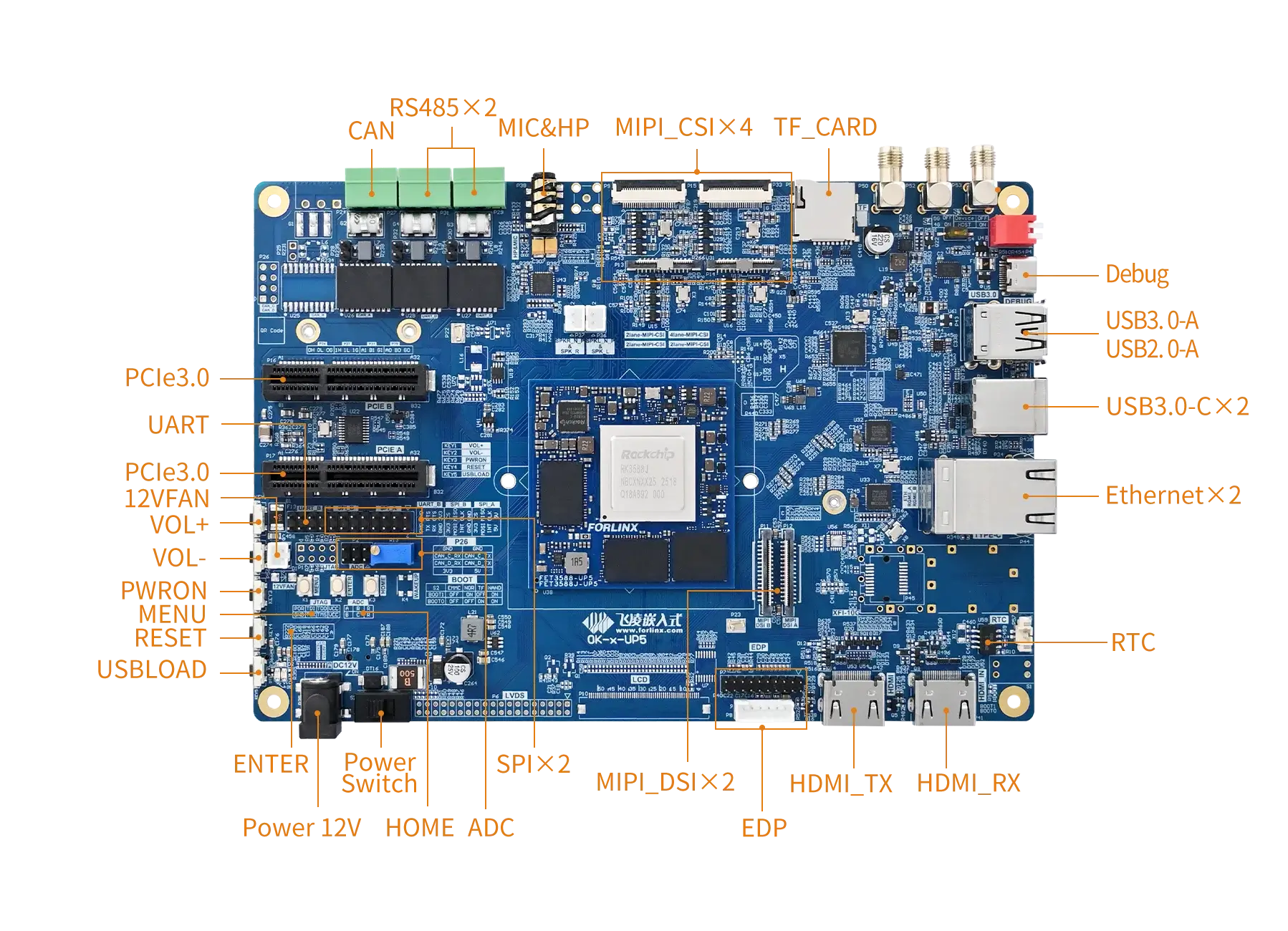
▊ RK3588 UP5 Carrier Board
|
|
| Development Board Function Parameters | ||
|---|---|---|
| Function | Quantity | Parameter |
| MIPI CSI | 4 | 1 x MIPI DPHY V2.0 4-lane interface, supporting up to 4.5 Gbps per lane; connected via a 26-pin FPC socket, with the OV13850 camera mounted by default; 3 x MIPI DPHY V1.2 2-lane interfaces, supporting up to 2.5 Gbps per lane; brought out via three 26-pin FPC sockets; pre-mounted with an OV5645 camera by default; |
| MIPI DSI | 2 | Each MIPI interface supports 4 lanes of output, with a maximum resolution of 4K@60fps; compatible with Feiling’s 7-inch MIPI display, with a resolution of 1024 x 600@30fps; supports separate display and touch functionality. |
| HDMI RX | 1 | Led out via a standard HDMI connector; supports up to 4K@60Hz. |
| HDMI TX | 1 | Led out via a standard HDMI connector; supports up to 7680x4320@60Hz. |
| eDP TX | 1 | Compatible with 1080p@60Hz displays; supports up to 4K@60Hz. |
| USB3.1 Gen1 | 2 |
Led out via the Type-C interface; Used in conjunction with DP TX, with data rates of up to 5 Gbps; |
| USB3.0 Host | 1 | Connected via a Type-A USB port, with transfer speeds of up to 5 Gbps; |
| USB2.0 Host | 1 | Led out via a Type-A USB interface; supports High-Speed (480 Mbps), Full-Speed (12 Mbps), and Low-Speed (1.5 Mbps) modes. |
| PCIe3.0 | 2 | 2x2-lane PCIe signals routed out via two PCIe x4 slots; supports data rates of 2.5 Gbps (PCIe 1.1), 5 Gbps (PCIe 2.1) and 8 Gbps (PCIe 3.0); |
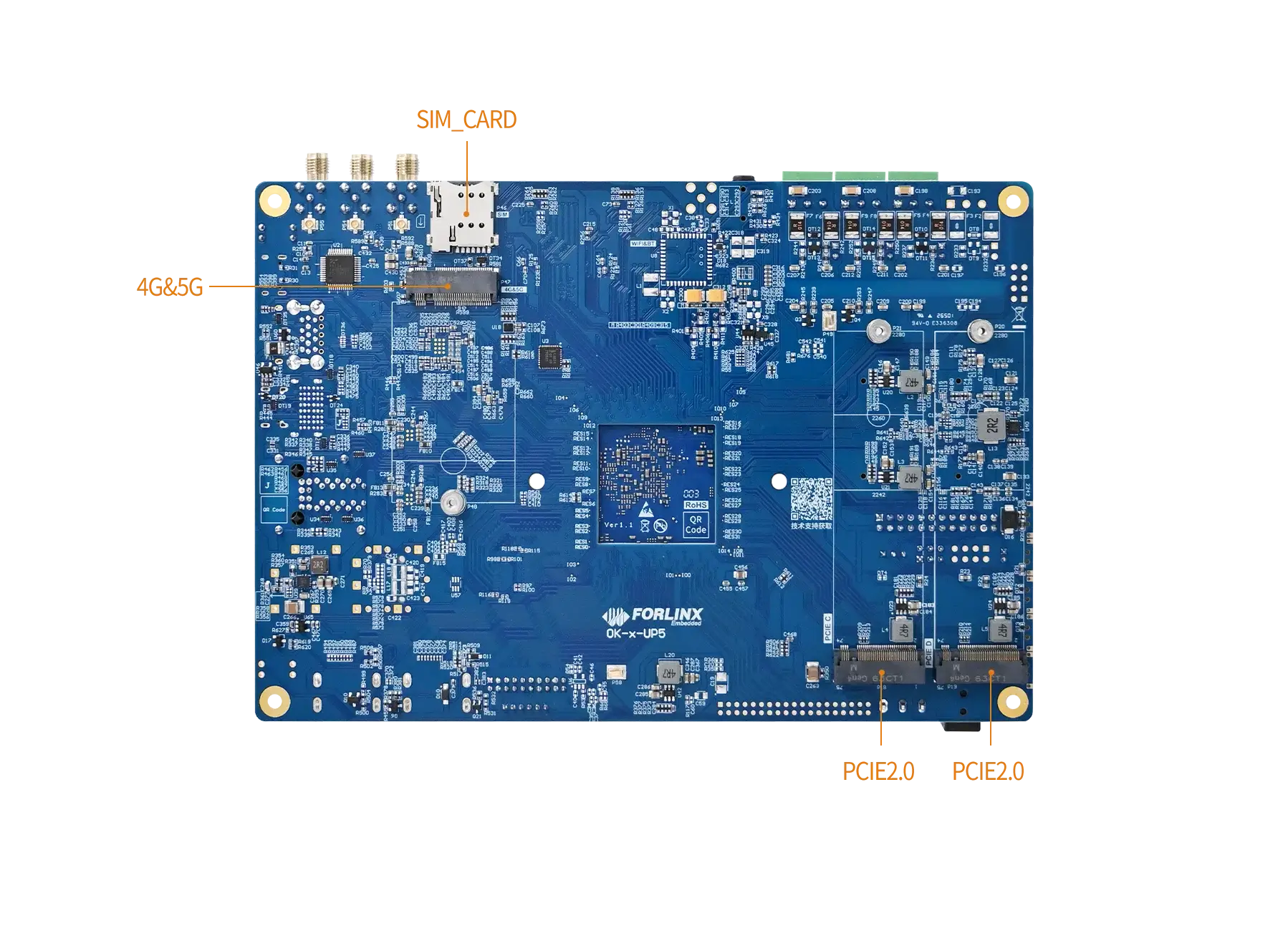
| PCIe2.0 | 2 | Led out via one M.2 M-Key slot; supports speeds up to 5 Gbps |
| Ethernet | 2 |
Led out via 2 x RJ45 interfaces; Supports 10/100/1000 Mbps data transmission rate. |
| TF Card | 1 | TF card is available, rate up to 150MHz,support SDR104 mode; |
| Audio | 1 | Codec chip on board, support headphone output, MIC input level Speaker output and other functions; |
| RS485 | 2 | 2 x RS485 CAN bus routed out through RS485 transceiver; |
| CAN | 1 | Connect one CAN bus via the CANFD transceiver; |
| UART | 1 | Led out via 2.54 mm pitch;Up to 4Mbps baud rate; |
| 4G/5G | 1 | Supports M.2 packaged 4G/5G modules; |
| WIFI&BT | 1 | Supports Wi-Fi and Bluetooth modules in M.2 form factor; Forlinx has adapted modules that support Wi-Fi 6 SU and MU-MIMO, as well as Bluetooth 5.3; |
| ADC | 5 | Led out via a PH2.0 socket; 12-bit resolution and a sampling rate of up to 1 MS/s; |
| RTC | 1 | Onboard RTC chip and battery socket; |
| SPI | 2 | Routed via a 2.54mm pitch connector; |
| FAN | 1 | Onboard fan connector; |
Note*: The parameters in the table are the theoretical values of hardware design or CPU.
▊ Accessories
Please click here to get more information about the supported modules and accessories.
▊ Documentation
Reference Manuals
Hardware Related
Product Datasheet
User Guide
Carrier Board Schematic
Carrier Board PCB
SoM Pinmux
Software & BSP
OS Image
Testing Demo
Source Code
Manual
Request a Quote
Fill out the form below for volume pricing or technical specifications. We'll get back to you within 24 hours.
▊ Ordering Information
1. Online Channels: We have an online store on Alibaba and DigiKey. Please contact us for details.
2. Direct Inquiry: For bulk orders, please email our sales team at [email protected].
3. Payment Method: Standard terms: 100% T/T (Telegraphic Transfer) in advance.
1. Dispatch Method: Orders are shipped via international express upon receipt of payment.
2. Lead Time: 5 working days for samples; 6 weeks for bulk orders.
3. Shipping Policy: Shipping and handling fees are the responsibility of the purchaser.
▊ Forlinx Recommended Products
Architecture: 4x Cortex-A76+4x Cortex-A55
Frequency: [email protected]/1.6GHz, [email protected]/1.3GHz
RAM: 4GB/8GB/16GB/32GB LPDDR4
ROM: 32GB/64GB/128GB eMMC
Architecture: 4x Cortex-A72 + 4x Cortex-A53
Frequency: [email protected][email protected]
RAM: 8GB LPDDR4,2GB/4GB LPDDR4
ROM: 16GB eMMC,32GB/64GB eMMC
Architecture: 4x Cortex-A72 + 4x Cortex-A53
Frequency: [email protected][email protected]
RAM: 8GB LPDDR4,2GB/4GB LPDDR4
ROM: 16GB eMMC,32GB/64GB eMMC