
Forlinx RV1126B: Dual DIS & EIS Image Stabilization for Smoother, Sharper Video
In video product development, image stabilization remains a key technical challenge. Even minor device vibrations can cause noticeable frame jitter, while fast-moving scenes can introduce motion blur and affect image clarity. As a result, effective image stabilization has become an important performance requirement for a wide range of applications, including handheld devices, automotive imaging systems, drones, and security surveillance equipment.
Traditional stabilization solutions often involve trade-offs. Mechanical gimbals provide effective physical stabilization but typically come with higher costs, increased weight, and potential maintenance issues caused by moving parts. Software-based stabilization, on the other hand, relies on image processing and frame cropping, which can reduce the field of view and compromise edge image information.
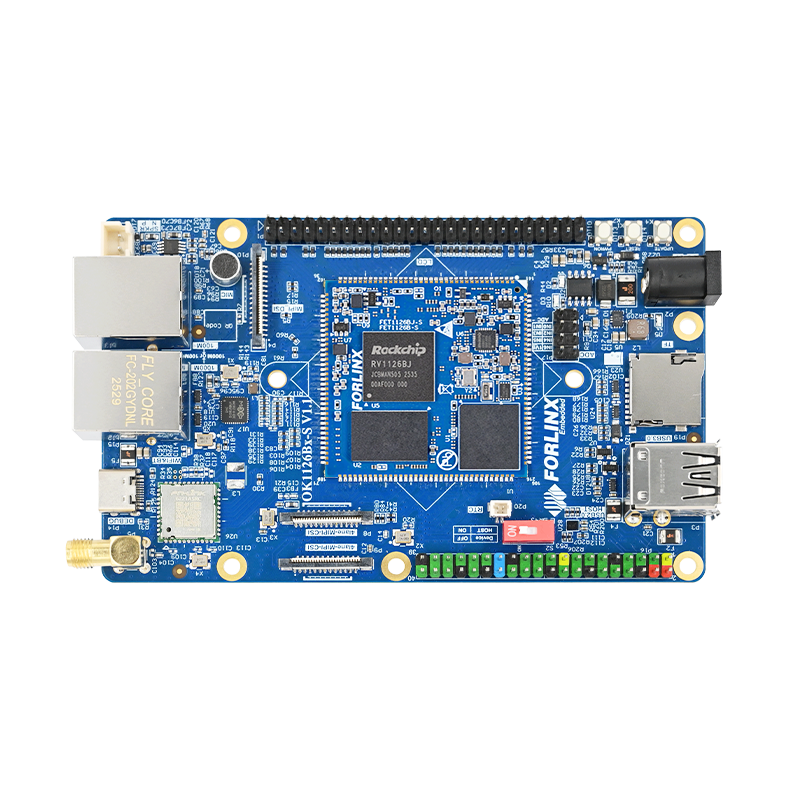
To address these challenges, Forlinx Embedded's OK1126B-C/OK1126B-S development boards support two image stabilization technologies: DIS (Digital Image Stabilization) and EIS (Electronic Image Stabilization). By offering these complementary stabilization approaches, the boards provide greater flexibility in balancing stabilization performance, system cost, and power consumption to meet the requirements of different embedded vision applications.
Understanding Image Stabilization: What Are the Main Types?
Image stabilization technologies can be broadly classified into five categories according to how camera motion is detected and how image shake is compensated:
One table says it all:
| Stabilization Technology | Working Principle | Advantages | Disadvantages | Applications |
|---|---|---|---|---|
| Optical Image Stabilization (OIS) | A gyroscope and accelerometer detect vibrations, and a motor drives the lens or sensor to move in the opposite direction | Zero loss to original image quality, excellent low-light performance, effective for telephoto shooting | Increases module weight and structural complexity, high hardware cost | Photography, low-light video recording, telephoto scenarios |
| Electronic Image Stabilisation (EIS) | Accelerometers + gyroscopes to detect jitter, and performs digital correction through image processing | No mechanical components required, low cost, supports firmware over-the-air updates | Relies on digital frame cropping; image quality degrades significantly under extreme shake | Video recording, compact small-form-factor devices |
| Hybrid Image Stabilization (HIS) | Fuses physical OIS compensation with digital EIS correction via data fusion | Combines the strengths of OIS and EIS for far stronger stabilization performance | Complex system architecture, high cost, introduces minor processing latency | High-end smartphones, professional industrial imaging equipment |
| Digital Image Stabilization (DIS) | Detects and corrects jitter purely through algorithms by comparing pixel differences between consecutive frames | 100% software-based, no extra dedicated hardware required, ultra-low implementation cost | High demands on the processor; image stabilisation is limited | Low-cost embedded devices, software-only lightweight solutions |
| Mechanical Stabilization | AKA gimbal/stabilizer, motors + gyroscopes to adjust the device’s attitude in real time | Ultra-high stabilization accuracy, no loss of image quality at all | Large in size and heavy in weight, high cost, complicated to operate | Professional cinematography, drones, 3-axis gimbal applications |
One commonly misunderstood distinction in the industry is the relationship between EIS and DIS. The two terms are sometimes used interchangeably in technical discussions and product specifications.
For clarity, this article distinguishes them according to their primary motion-sensing mechanisms:
- EIS relies on dedicated motion sensors, such as gyroscopes and accelerometers, to obtain motion information and calculate image compensation.
- DIS estimates motion directly from image sequences through inter-frame analysis, without requiring additional motion sensors.
Why choose Rockchip RV1126B chip?
GDC Hardware Acceleration Feature
Geometric distortion correction + rotation compensation is handed over to a dedicated hardware unit, which does not occupy CPU resources and does not drag down the performance of the whole machine.
Advanced ISP Architecture
It supports MEMC, with a built-in NPU. The ISP35 platform is equipped with complete pipelines for image preprocessing and AI noise reduction, so the image quality remains uncompromised both before and after stabilization.
Sensor-free DIS Implementation
This pure-image 4-DOF (4 Degrees of Freedom) global motion estimation can be directly connected to the VI (Video Input) channel, enabling deployment without hardware modifications — ideal for low-cost and fast implementation.
High-precision EIS Implementation
Paired with the ICM42670 6-axis gyroscope that supports 800Hz sampling, and with timestamps aligned to the monotonic clock, the system maintains excellent stabilization performance even under high-speed motion.
Key Parameters: A set of verifiable real-world figures
| Parameter Item | Configuration: |
|---|---|
| Input Resolution | 3840×2160 (4K) |
| Output Resolution | 1920×1080 (scaled via VPSS, freely adjustable within the range from 4K to 640×480) |
| Frame Rate | 30 fps |
| DIS Cropping Range | 50%~98%(configurable) |
| EIS Gyroscope | ICM42670@800Hz |
| Output Interfaces | Supports RTSP streaming for direct stream pulling via ffplay; also compatible with display devices such as MIPI and HDMI |
Data Flow: A Well-defined Technical Pipeline
On RV1126B, the DIS and EIS modules share a single hardware link while operating on their respective independent compensation channels:
VI (Video Input for Image Capture)
  ├─ DIS Mode: 4-DOF GME (4 Degrees of Freedom Global Motion Estimation) is directly mounted on the VI channel for stabilization processing
  └─ EIS Mode: Gyroscope IMU data → GDC hardware performs rotation compensation
  ↓
VPSS (Video Post-Processing Subsystem)
  ↓
VENC (H.264 Encoding)
  ↓
RTSP Streaming (direct stream pull for validation via ffplay)
DIS Implementation Workflow:
Call RK_MPI_VI_SetChnDISConfig and RK_MPI_VI_SetChnDISAttr to mount the DIS module on the VI channel. The workflow adopts DIS_MODE_4_DOF_GME (4 Degrees of Freedom Global Motion Estimation: supporting translation, rotation and scaling), which relies purely on image signals and requires no gyroscope. The cropping range is configurable from 50% to 98%, but the configuration must be completed before enabling the corresponding VI channel via RK_MPI_VI_EnableChn.
EIS Implementation Workflow:
The EIS processing runs through the dedicated EIS channel of GDC (Geometric Distortion Correction) hardware, namely GDC_CHN_MODE_EIS, to perform rotation compensation by fusing data from the ICM42670 gyroscope. Note: This is not simply enabling the GYRO mode of the DIS module. The DIS module at the VI layer only supports pure-image global motion estimation. Gyroscope-assisted stabilization must be executed through this independent GDC EIS channel.
Core Technical Challenges of EIS: Precise Timestamp Synchronization and Extrinsic Calibration
The gyroscope provides data based on its sampling speed, while the image frame delivers data according to the exposure speed of the video image (VI). For Electronic Image Stabilization (EIS) to accurately determine which section of attitude change corresponds to each image frame, the two data sets must be synchronized to the same time base. We have accumulated extensive practical experience in this field, and all pain points have been verified one by one on the development board:
Preventing IMU FIFO Overflow
The default I2C bus clock is 100kHz, where reading full-volume FIFO data takes 92ms, which completely fails to match the 800Hz sampling rate and directly causes continuous FIFO overflow. Increasing the bus clock to 400kHz can completely resolve this fault.
IMU-to-Camera Extrinsic Calibration
If the installation orientation of the IMU deviates from the preset reference, the motion compensation effect will directly fail.
IMU Sampling Configuration
ICM42670 six-axis gyroscope, 800 Hz ODR, I²C interrupt mode (INT1 triggered via GPIO, non-polling).
Clock Synchronisation
At the driver layer, specify the clock of the IIO device as CLOCK_MONOTONIC, which is aligned with the timestamp of image frames. Otherwise, the EIS engine will continuously report “zero gyroscope data”; if there are errors in the camera’s intrinsic calibration or calculation methods, noticeable pixel stretching will occur when the EIS algorithm is executed.
All the above tuning difficulties have gone through full-process verification, and users can directly reuse the mature mass-production validated solution to skip the most time-consuming parameter tuning phase.
DIS vs. EIS: Performance Comparison and Technical Advantages
Digital Image Stabilization (DIS)
The left figure shows the original video stream, and the right figure shows the video stream optimized by the DIS algorithm. DIS can achieve basic image stabilization, requires no additional hardware, and has a low debugging threshold, making it the preferred solution for security monitoring devices such as IP Cameras (IPC). It can also achieve a certain degree of stabilization compensation for large-span low-frequency motions.
Electronic Image Stabilization (EIS)
Small-amplitude low-frequency motion (such as normal walking scenarios): Compared with DIS, EIS has significant advantages in scenarios with small jitters.
Large-amplitude low-frequency motion (such as jogging scenarios): The optimization effect of EIS for such dynamic scenarios is also outstanding.
Horizon Intelligent Stabilization
Based on the new-generation intelligent stabilization algorithm, it can independently identify full-dimensional jitters of the device and complete effective cancellation, supporting precise compensation for arbitrary horizontal rotation. In extreme scenarios such as severe bumps and fast rotation, it always maintains the horizontal reference stability of the picture.
Solution Deployment Scenarios
Scenarios Where EIS Excels:
- Drones / high-speed action cameras: During high-speed maneuvers and rapid turns, the motion in the frame far exceeds what image-based estimation can track. Stabilization has to rely on IMU angular velocity alone to compute attitude compensation — this is where EIS truly shines.
- Low-light / nighttime shooting: DIS depends on image quality and breaks down in low light; EIS runs on the IMU, so lighting has no effect at all. Nighttime dashcams and night-time security cameras are clear-cut use cases.
- Pure-colour/low-texture environments: The sky, the sea, snow-covered ground, white walls—as the images lack distinctive features, DIS is unable to make an estimate; EIS, however, does not rely on texture for its IMU and remains stable.
- Scenarios requiring high-precision attitude compensation: Auxiliary compensation for gimbal cameras and products requiring the output of stable attitude data (for positioning/navigation using IMU fusion) — the IMU data itself is of value.
- High-end automotive/front ADAS cameras: In dynamic scenarios such as bumpy roads, sudden braking, and sharp turns, the response speed and compensation accuracy of EIS are significantly better than pure image stabilization solutions.
Scenarios Where DIS Excels:
- Fixed/low-frequency vibration security monitoring: Applicable to micro-jitter compensation for box cameras, dome cameras, and PTZ cameras. In such scenarios, the picture is dominated by static backgrounds with rich image features, the DIS stabilization effect is excellent, and it hardly increases BOM (Bill of Materials) cost.
- Low-power handheld devices/entry-level action cameras: Adapt to product forms with limited budget, unable to carry mechanical gimbals, and no extra space to arrange gyroscopes. For small-amplitude jitters such as handheld walking and slow follow shooting, DIS can fully meet the stabilization requirements.
- Dashcams on Smooth Roads: Used to suppress picture jitters caused by micro-bumps on the road during normal driving. In this scenario, features such as roads, vehicles, and traffic markings in the picture are clear, and the global motion estimation results are stable and reliable.
- Indoor Inspection/Robot Vision: Adapt to mobile operation platforms with stable indoor lighting and slow moving speed. The lighting conditions are controllable, and the pure image stabilization solution can fully cover the requirements.
- Products Requiring Rapid Prototyping to Verify Stabilization Value: No need to modify the hardware design or re-prototype the PCB. The stabilization effect can be intuitively verified once the solution runs, which is suitable for projects that need to complete demand verification first before evaluating whether to upgrade to the EIS solution.
Closing Remarks
As mobile vision, intelligent imaging, and handheld camera applications continue to expand, stable video output and advanced image processing capabilities have become increasingly important to product competitiveness.
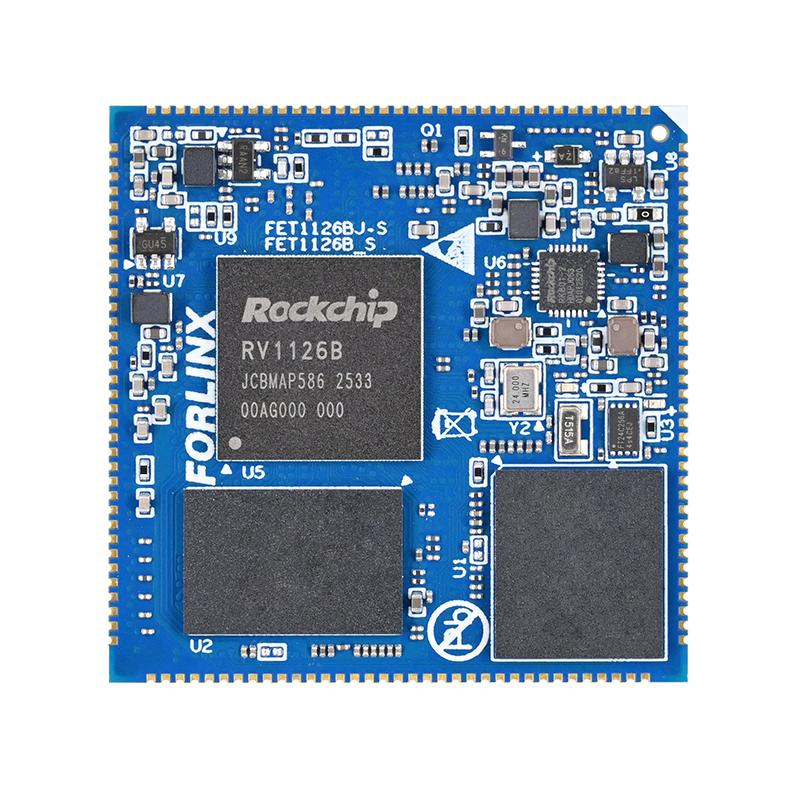
Forlinx Embedded's FET1126B-C/FET1126B-S SoMs, based on the Rockchip RV1126B platform, provide a dual-mode DIS and EIS stabilization solution that combines sensor-free image-based motion estimation with high-precision IMU-assisted motion compensation.
By leveraging GDC hardware acceleration, advanced ISP processing, flexible stabilization architectures, and optimized sensor integration, the solution helps developers balance stabilization performance, hardware cost, and power consumption across different application requirements.
More importantly, Forlinx provides more than just hardware. We offer an integrated development solution backed by technical documentation, verified implementation experience, and professional engineering support.
From timestamp synchronization and FIFO overflow optimization to IMU driver adaptation and sensor-to-camera calibration, our technical support helps reduce complex hardware-software integration efforts, shorten development cycles, and improve project efficiency.
Whether the target application is security surveillance, automotive imaging, drones, action cameras, industrial inspection, robot vision, or other intelligent imaging terminals, the RV1126B-based solution provides a flexible foundation for developing reliable embedded vision products.
Forlinx Embedded is committed to helping customers accelerate product development and bring innovative intelligent imaging solutions to market. We look forward to working with industry partners to explore new opportunities in embedded vision and intelligent imaging.